Why “Pre vs Post” Prefixes Matter in English Writing
Understanding pre vs post is not just about grammar. It helps you speak clearly and avoid confusion in daily life. Many people search for the difference between pre and post because these small prefixes completely change meaning.
When you use the wrong prefix, your message can flip. For example, “preapproval” and “postapproval” do not mean the same thing at all. One happens before, the other happens after.
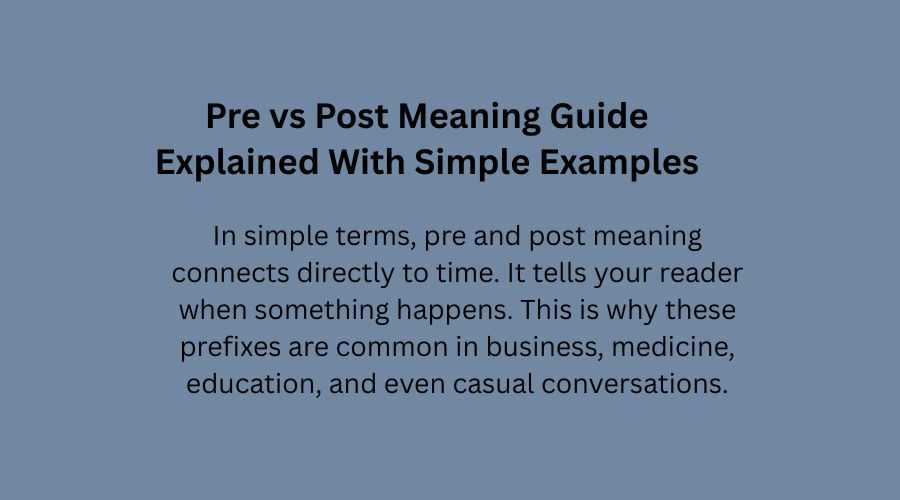
In simple terms, pre and post meaning connects directly to time. It tells your reader when something happens. This is why these prefixes are common in business, medicine, education, and even casual conversations.
If you want to sound clear and confident, learning post and pre meaning is a must. It also improves your writing skills and helps you understand new words quickly.
Transfering or Transferring? Most People Get This Wrong
Inexcusable Vs Unexcusable: What’s The Correct Word To Use?
What Are Prefixes in English? Understanding Pre vs Post Basics
Prefixes are small groups of letters added at the beginning of a word. They change the meaning of that word.
For example, when you add “pre” to heat, you get preheat, which means heating before something. When you add “post” to war, you get postwar, meaning after the war.
This shows how pre and post affect meaning instantly.
Prefixes help in building vocabulary. They also make communication faster because one word can express a full idea.
Quick Comparison Table for Prefix vs Suffix vs Root
A prefix comes at the start of a word. A suffix comes at the end. A root word is the base meaning.
For example, in “preview,” “pre” is the prefix and “view” is the root. In “happiness,” “ness” is the suffix.
Understanding this structure helps you decode new words easily. That is why learning prefixes like pre vs post meaning is so useful.
Pre vs Post Meaning Explained Clearly With Examples
The difference between pre and post is simple but powerful.
“Pre” means before something happens.
“Post” means after something happens.
This is the core idea behind post vs pre meaning.
If you remember just this, you can understand hundreds of English words.
For example, pregame means before the game. Postgame means after the game. The same pattern works in many situations.
Visual Timeline of Pre vs Post
Think of time as a straight line.
Before the event is pre.
The event happens.
After the event is post.
This simple timeline helps you remember the concept forever. Many learners confuse these terms, but this method makes it easy.
Latin Roots Behind Pre vs Post Meaning
English borrows many words from Latin. Both “pre” and “post” come from Latin roots.
“Pre” comes from “prae,” which means before.
“Post” comes from “post,” which means after.
These meanings stayed the same over time. That is why modern English still uses them clearly.
This history explains why pre and post meaning feels logical. These prefixes have always been about time and sequence.
When you understand their origin, remembering post and pre meaning becomes easier.
When to Use Pre Prefix Correctly
Use “pre” when something happens before an event, action, or condition.
This is the basic rule for using pre correctly.
You will see this prefix in situations related to preparation or planning.
Common Pre Examples in Daily English
Words like preheat, preview, prepay, and preorder are very common.
Preheat means heating before cooking.
Preview means seeing something before release.
Prepay means paying before using a service.
Each word clearly shows the idea of “before.”
Real Life Applications of Pre
In business, companies do prelaunch marketing before releasing products.
In medicine, prenatal care happens before birth.
In education, students take a pretest before starting a course.
These examples show how important pre and post are in real life.
When to Use Post Prefix Correctly
Use “post” when something happens after an event.
This is the main rule for using post correctly.
It is often used when talking about results, reactions, or consequences.
Common Post Examples in Daily English
Words like postwar, postgraduate, and postscript are widely used.
Postwar means after a war.
Postgraduate refers to study after a degree.
Postscript is something added after a letter.
These examples clearly show “after.”
Real Life Applications of Post
In media, postproduction happens after filming.
In healthcare, postnatal care happens after birth.
In business, post-sale services happen after a purchase.
This makes the difference between pre and post very practical.
Pre vs Post Side by Side Comparison
The easiest way to understand post vs pre meaning is by comparing them directly.
Pre is always about before.
Post is always about after.
Pre is used in preparation stages.
Post is used in reflection or result stages.
For example, premeeting notes are written before a meeting. Postmeeting reports are written after.
This simple comparison helps remove confusion completely.
Common Mistakes in Pre vs Post Usage
Many learners make mistakes when using these prefixes.
One common mistake is thinking “postpone” means after. It actually means to delay something.
Another mistake is confusing preexisting with postexisting. Preexisting means something already existed before.
People also confuse pre with pro. Pro means in favor of something, not before.
Similarly, retro means going back in time, while post means after.
If you avoid these mistakes, your understanding of pre and post meaning becomes stronger.
Practical Tips to Remember Pre vs Post Easily
You can use simple tricks to remember these prefixes.
Think of “pre” as prepare. You prepare before something.
Think of “post” as after posting something online. You post after an event.
Another useful method is visualizing a timeline. Imagine an event in the middle. Everything before is pre. Everything after is post.
You can also connect these words with daily actions. You prepay bills and post reviews.
These tricks make learning pre vs post meaning easy and natural.
How Pre vs Post Improves Writing Clarity
Correct use of prefixes improves your writing.
When you use pre and post properly, your reader understands exactly what you mean.
For example, saying preapproval instead of approval shows that the action happens before.
Clear communication is important in professional writing. Mistakes can lead to confusion.
In business, wrong usage can cause misunderstandings. In academic writing, it can affect credibility.
So learning the difference between pre and post is not just grammar. It is about clarity and confidence.
Advanced Use of Pre vs Post in Different Fields
These prefixes are used in many professional areas.
In medicine, prenatal and postnatal are common terms.
In education, pretest and post-test are widely used.
In business, prelaunch and postlaunch are key strategies.
In media, preproduction and postproduction define stages of work.
This shows that post vs pre meaning is not limited to basic English. It is used everywhere.
Related English Confusions Like Pre vs Post
English has many confusing word pairs.
Some people even mix unrelated words like chappy or pre and post meaning, which shows how confusing language can feel.
Other confusing pairs include peak, peek, and pique.
Some time, sometime, and sometimes also confuse learners.
Understanding prefixes like pre and post helps reduce these confusions.
FAQs About Pre vs Post Meaning
What does pre mean in simple terms?
Pre means before something happens. It is used to describe actions or events that occur earlier than a main event or situation.
What does post mean in simple terms?
Post means after something happens. It refers to actions or situations that take place following a main event or completed action.
What is the difference between pre and post?
The difference between pre and post is timing. Pre refers to before an event, while post refers to after the event has already happened.
When should I use pre vs post in a sentence?
Use pre when talking about something before an event. Use post when referring to something happening after the event or action is completed.
How do prefixes like pre and post change meaning?
Prefixes like pre and post change a word’s meaning by adding time context. They show whether something happens before or after the main event.
Conclusion
Understanding pre and post gives you control over time based language. These prefixes help you explain when something happens with clarity. You can avoid confusion and communicate better in writing and speaking. Learning the difference between pre and post also improves vocabulary and confidence. When you use them correctly, your message becomes clear and professional. Keep practicing real examples in daily life. Over time, using pre vs post meaning will feel natural and effortless. Small words can create big impact when used correctly.
Wise vs Wize: When To Use Each One? What To Consider
Ceil vs Seal vs Seel: Differences And How To Use Them Correctly
Which vs Wich vs Witch: Differences And How To Use Them Correctly