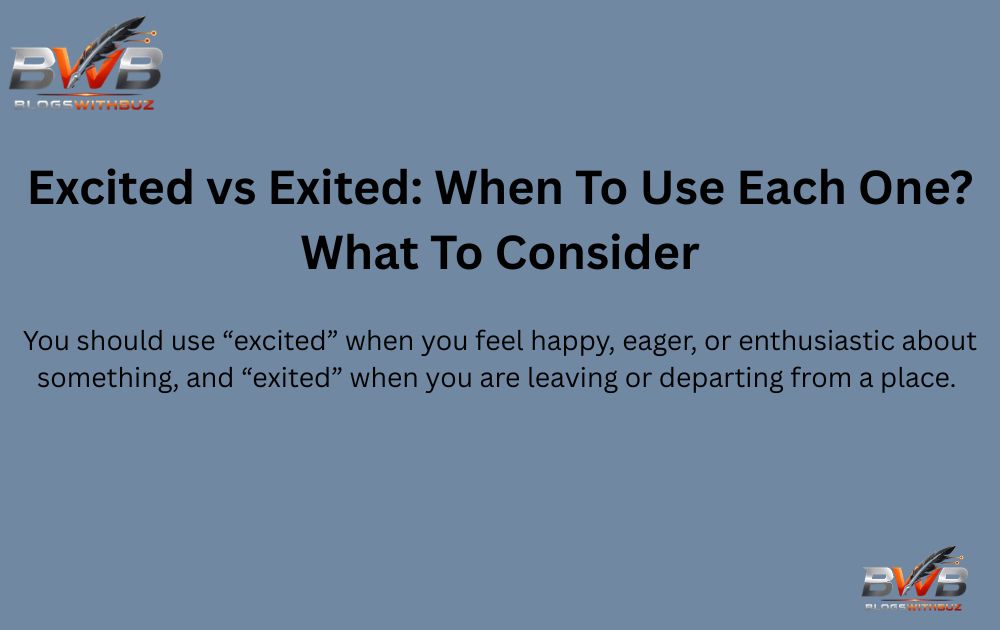
You should use “excited” when you feel happy, eager, or enthusiastic about something, and “exited” when you are leaving or departing from a place. Many people confuse these two words because they sound similar, but their meanings are very different. Excited is an adjective used to describe emotions, anticipation, or enthusiasm. For example, “The children were excited to open their presents.” On the other hand, exited is a verb that shows physical movement or leaving, such as “He exited the building quickly after the meeting.”
Understanding the difference helps you avoid common grammar mistakes and communicate clearly. Context matters: use excited for positive feelings and anticipation, and exited for actions like leaving a room, building, or event. Paying attention to these rules improves your English writing skills and makes your sentences accurate, professional, and easy to understand.
Define Excited
Excited means feeling happy, eager, or full of enthusiasm. It is an adjective used to describe emotions, anticipation, or thrill about something happening or about to happen. For example, a child may feel excited to open birthday presents, or a sports fan may be excited to watch a championship game.
Excited often involves physical or emotional arousal, like a racing heart or smiling. Using excited correctly in sentences improves your English grammar, avoids mistakes, and clearly expresses positive emotions, eagerness, and anticipation.
Define Exited
Exited means leaving or departing from a place or situation. It is a verb that describes physical movement when someone goes out of a room, building, or event. For example, passengers exited the airplane after landing, or someone exited a meeting early. Exited focuses on actions, not feelings, and is often confused with excited.
Using exited properly improves English sentence structure, avoids grammar mistakes, and clearly conveys movement, departure, or completion of an action.
How To Properly Use The Words In A Sentence exited or excited
To use excited and exited correctly, first understand their meanings. Excited describes feelings of enthusiasm, eagerness, or anticipation, while exited describes leaving or departing from a place. Using them incorrectly can confuse readers. Always pay attention to context, whether you are talking about emotions or actions. Choosing the right word improves English grammar, sentence clarity, and communication skills.
How To Use “Excited” In A Sentence
Excited is an adjective used to show emotions, anticipation, or eagerness. Example sentences:
- “I am excited to start my new job next week.”
- “The children were excited to see the circus.”
- “She was excited about the concert and could hardly sleep.”
Use excited to describe a person, place, event, or idea that makes someone feel enthusiastic or thrilled. Avoid using it as a verb.
How To Use “Exited” In A Sentence
Exited is a verb used to describe leaving or moving out of a place or situation. Example sentences:
- “The passengers exited the airplane after it landed.”
- “He quickly exited the meeting when he realized he was in the wrong room.”
- “She exited the building and walked to her car.”
Use exited for actions, not emotions. Always pair it with the location or situation someone is leaving.
More Examples Of Excited & Exited Used In Sentences
Using excited and exited correctly helps avoid grammar mistakes and improves sentence clarity. Below are real-life examples showing the difference between emotions and actions.
Examples Of Using “Excited” In A Sentence
- I am so excited to go on vacation next week.
- She was excited to hear she got the job.
- The children were excited to open their Christmas presents.
- We were excited to try the new restaurant in town.
- He was excited to see his favorite band perform live.
- She was excited to start her new business venture.
- The fans were excited to meet their favorite athlete.
- He was excited to announce the launch of his new book.
- She was excited to attend the fashion show.
- We were excited to watch the fireworks display.
Tip: Use “excited” when describing positive feelings, anticipation, or eagerness.
Examples Of Using “Exited” In A Sentence
- The dog exited the room when the door was opened.
- He exited the building after the fire alarm went off.
- She exited the car and walked toward the store.
- The airplane exited the runway and took off into the sky.
- He quickly exited the conversation when he realized it was going nowhere.
- She exited the elevator on the wrong floor.
- The train exited the tunnel and entered the station.
- The car exited the highway and took the exit ramp.
- He exited the theater after the movie ended.
- She exited the pool and dried off with a towel.
Tip: Use “exited” to describe leaving, departing, or completing a physical action.
Common Mistakes To Avoid
Many people confuse excited and exited because they sound similar. Using them incorrectly can lead to misunderstanding in writing and speaking. Let’s look at the most common mistakes and how to avoid them.
Using Excited And Exited Interchangeably
A common error is swapping the words. Excited shows enthusiasm or anticipation, while exited describes leaving or departing.
- ❌ Incorrect: I was exited to go to the party.
- ✅ Correct: I was excited to go to the party.
- ❌ Incorrect: She was so excited when she exited the building.
- ✅ Correct: She was so excited when she left the building.
Remember: Context matters—use excited for feelings and exited for actions.
Confusing Exited With Exhausted
Some confuse exited with exhausted because they sound alike. Exited = leaving; exhausted = extremely tired.
- ❌ Incorrect: After the long hike, I was so exited.
- ✅ Correct: After the long hike, I was so exhausted.
Tips For Avoiding These Mistakes
- Learn the meaning of each word clearly.
- Proofread your writing to check for correct usage.
- Read sentences aloud to see if they make sense.
- Ask someone to review your writing for errors.
- Focus on context—emotion or action—to choose the right word.
Context Matters
Choosing between excited and exited depends on the situation. Understanding the context ensures you convey the right meaning and avoid grammar mistakes. Excited expresses positive emotions, eagerness, or anticipation, while exited shows leaving, departing, or physical movement. Always think about whether you are describing feelings or actions before choosing the word.
Examples Of Different Contexts
| Context | Example Sentence | Correct Word |
| Positive Emotion | I’m so _____ to go on vacation! | Excited |
| Negative Emotion | She _____ the meeting early because she was angry. | Exited |
| Physical Movement | The crowd _____ the stadium after the game. | Exited |
| Completion of a Task | He _____ the building after finishing his work. | Exited |
| Anticipation | The children were _____ for Santa’s arrival. | Excited |
Tip: Use excited for feelings, enthusiasm, and anticipation, and exited for actions, departures, or movements. Paying attention to context improves your English writing and communication skills.
Exceptions To The Rules
While the rules for using excited and exited are usually straightforward, there are some exceptions. These rare cases depend on regional usage, context, technical fields, or slang. Understanding these exceptions helps you use English more naturally and accurately.
1. Regional Differences
In some regions, especially in parts of the United States, people may use excited to mean “worked up” or “agitated.” In these cases, exited would not make sense. For example:
- “He was excited about the argument.” (Here, excited = worked up, not thrilled)
2. Contextual Meanings
Sometimes, the usual meanings change depending on context:
- “I exited the building.” → exited means “left.”
- “I’m excited to leave.” → excited means “looking forward to.”
Context helps determine whether the word describes emotion or action.
3. Technical Jargon
In science or physics, exited can describe particles moving to a higher energy level, which is very different from everyday usage. In this case, excited cannot replace exited.
4. Slang And Colloquialisms
Online communities sometimes use exited as a playful misspelling of excited. For example:
- “I’m so exited for the concert!” → meant humorously or casually.
Even in slang, context matters—readers should understand whether it’s humor, emotion, or action.
Practice Exercises
Exercise 1: Fill In The Blank
Choose the correct word (excited or exited) to complete each sentence:
- I am _____ to start my new job next week.
- She _____ the room quickly when she saw the spider.
- The crowd was _____ when the band started playing.
- He _____ the building when the fire alarm went off.
- We were all _____ to hear the news about the promotion.
Answer Key:
- excited
- exited
- excited
- exited
- excited
Exercise 2: Sentence Completion
Complete each sentence using excited or exited:
- She was so _____ to see her best friend after many years.
- He _____ the room and slammed the door behind him.
- The children were _____ to go to the amusement park.
- We were all _____ to hear the results of the election.
- She _____ the car and ran into the store to buy some milk.
Answer Key:
- excited
- exited
- excited
- excited
- exited
Tip: Excited = feelings, anticipation, or enthusiasm. Exited = leaving or departing. Practicing these exercises strengthens English grammar, sentence clarity, and proper word usage.
Conclusion
The words excited and exited are often confused because they sound similar, but their meanings are very different. Excited expresses enthusiasm, anticipation, or eagerness, while exited shows leaving, departing, or physical movement. Using the correct word in the right context improves English writing, communication skills, and sentence clarity.
Key Takeaways:
- Excited = positive emotions, eagerness, anticipation.
- Exited = leaving, departing, or completing an action.
- Context matters—always check whether you’re describing emotion or action.
- Avoid common mistakes by proofreading and practicing exercises.
- Understanding exceptions like regional differences, slang, and technical jargon helps you use these words correctly in all situations.
FAQs
What is the difference between excited and exited?
- Excited describes feelings of enthusiasm, eagerness, or anticipation.
- Exited describes leaving, departing, or moving out of a place.
Can I use exited instead of excited?
No. Using them interchangeably is a common mistake. Excited is for emotions, exited is for actions.
is exited ever used in slang
Yes. In some online communities, “exited” is used humorously as a misspelling of excited, but context matters.
How do I remember the difference between excited and exited?
Think: Excited = emotions, Exited = exit or leaving. Context is key.
Can excited be used as a verb?
No. Excited is an adjective. Using it as a verb is incorrect.
Gases or Gasses: Which One Is Actually Correct?
Setup vs Set Up vs Set-up: The Complete Grammar Guide
Into vs In To: The Complete Grammar Guide for Students (With Examples and Quiz)