Chris’s or Chris’ — Which Is Correct? Grammar Rules, Examples & Tips
If you have ever typed a name ending in S and then stopped, unsure whether to write Chris’s or Chris’, you are not alone. This tiny punctuation decision confuses even experienced writers every day. The good news is that both forms are actually correct. However, the right choice depends on your writing style, your audience, and the style guide you follow. So let us break it all down clearly and simply.
Investor vs Investee: How Are These Words Connected?
Stub vs Stab: When to Opt for One Term Over Another
Labeler vs Labeller: How Are These Words Connected?
Labeler vs Labeller: How Are These Words Connected?
Quick Answer: Chris’s or Chris’?
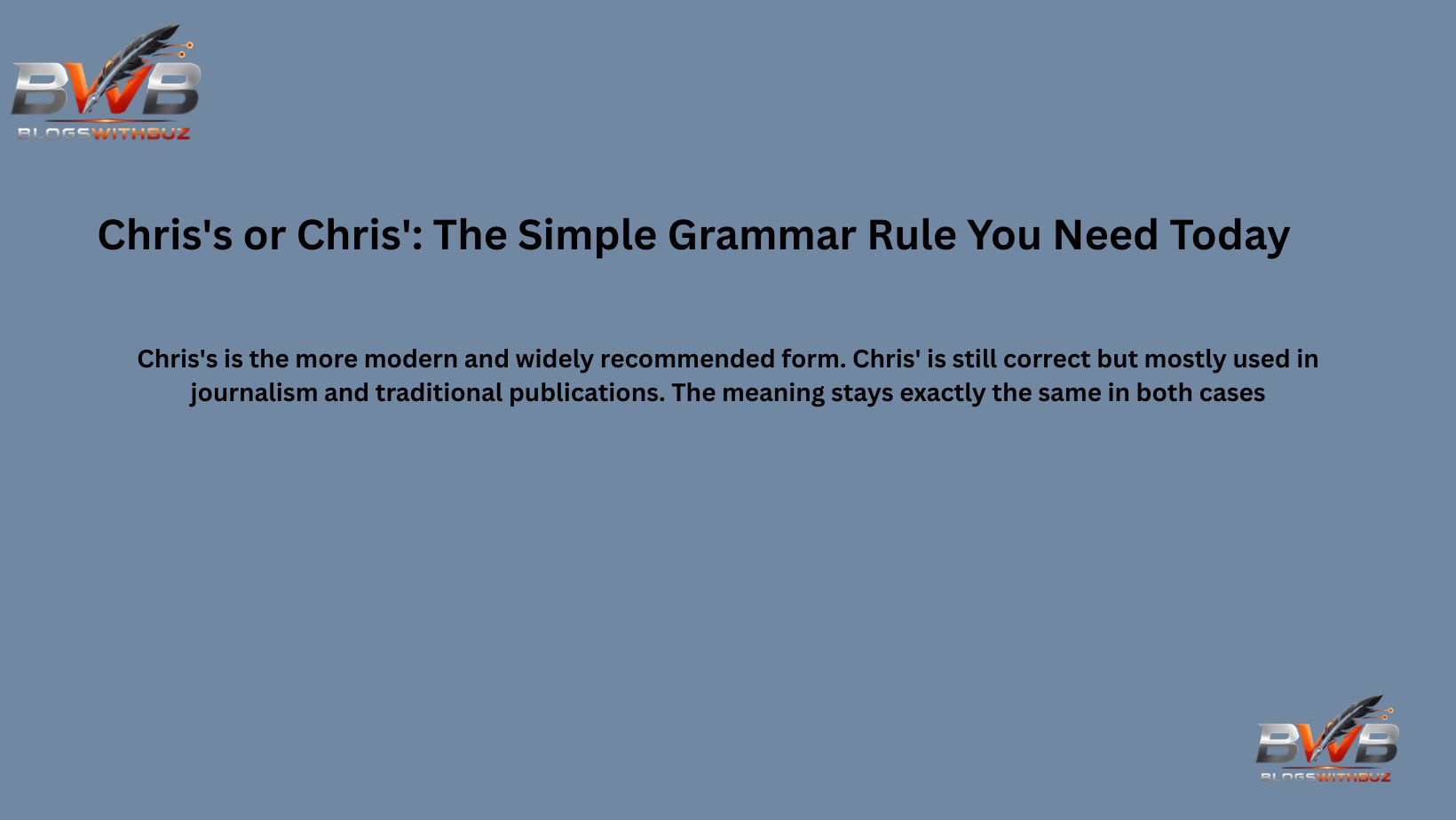
Both chris’s or chris’ are grammatically acceptable in English. Chris’s is the more modern and widely recommended form. Chris’ is still correct but mostly used in journalism and traditional publications. The meaning stays exactly the same in both cases. Something belongs to Chris, whether you write Chris’s book or Chris’ book. The difference is only about style, not about right or wrong.
The Origin of Chris’s or Chris’
English grammar has always had a possessive rule. You add apostrophe plus S to a noun to show ownership. That rule worked fine for most words, but names ending in S created a problem. Writers and grammar teachers started debating whether to add another S after the apostrophe or just leave it with the apostrophe alone.
Why Names Ending in S Cause Confusion
When you say Chris’s out loud, the extra S sound is very soft. Some people drop it completely in speech. Because of that, older grammar traditions tried to match writing with pronunciation. So they allowed Chris’ without the extra S. That is where the split began, and writers have been confused ever since.
How Apostrophe Rules Evolved Over Time
Over time, modern English moved toward clarity and consistency. Grammar experts decided that adding ‘s to singular nouns, even those ending in S, made writing clearer and easier to read. That is why today, most style guides recommend chris’s as the standard possessive form. Still, the older form Chris’ never disappeared completely, especially in news writing.
Chris’s or Chris’ Grammar Rules Explained
Understanding chris’s or chris’ grammar makes the whole thing much easier. The basic possessive rule in English says: add apostrophe plus S to a singular noun to show possession. Chris is a singular noun. So following that rule, Chris becomes Chris’s. Simple as that.
The Standard Possessive Rule
The standard rule applies to all singular nouns, including those ending in S. So just like you write James’s car or Gus’s bag, you also write Chris’s jacket. This rule keeps your writing consistent and easy to follow. Most modern grammar books support this approach.
When to Add ‘s vs. Just an Apostrophe
You use just an apostrophe without the extra S only in specific situations. For plural nouns ending in S, you skip the extra S. For example, the teachers’ lounge uses just an apostrophe because teachers is already plural. But Chris is singular, so adding ‘s is the correct move in most writing styles.
What Major Style Guides Say
Different style guides give slightly different advice, and that is where things get interesting. The Chicago Manual of Style recommends Chris’s. The APA and MLA style guides also support Chris’s for singular possessives. However, the AP Style Guide, which journalists follow, recommends Chris’ without the extra S. So if you are writing for a newspaper, Chris’ is fine. For almost everything else, go with Chris’s.
Chris’s or Chris’ in British vs. American English
Many writers wonder if the answer changes depending on which version of English they use. The short answer is not really. Both British and American English now mostly prefer Chris’s as the standard possessive form.
American English Preference
In American English, Chris’s is the widely accepted and commonly used form. Academic papers, business emails, blog posts, and educational content in the United States almost always use Chris’s. It follows the standard possessive rule and feels natural to most American readers.
British English Preference
British English also leans toward Chris’s in modern usage. While older British texts sometimes used Chris’, contemporary British writing, including books, websites, and formal documents, uses Chris’s most of the time. So no matter which side of the Atlantic you are on, Chris’s is the safer and more accepted choice today.
Which One Should You Use: Chris’s or Chris’?
Choosing between chris’ or chris’s really comes down to three things: your audience, your purpose, and the style guide your writing follows. Make sure you pick one form and stick to it throughout your entire piece. Mixing both forms in the same article creates confusion and makes your writing look careless.
For Academic Writing
If you are writing a research paper, essay, or any formal academic document, always use Chris’s. APA, MLA, and Chicago all support this form. It follows the standard possessive rule and will make your writing look polished and professional.
For Journalism and News
Journalists working under AP Style should use Chris’. That is the official recommendation from the Associated Press, and most newspapers and news websites follow it strictly. So if you are writing a news article or press release, Chris’ is the right call.
For Blogs, SEO and Digital Content
For blog posts, website content, and SEO writing, Chris’s is absolutely the better option. It looks cleaner, ranks more naturally in search engines, and matches what most online readers expect to see. Search engines also tend to index Chris’s more frequently, which gives it a small but real advantage in digital writing.
Common Mistakes to Avoid with Chris’s or Chris’
Even writers who know the rule make small errors with possessive apostrophes. Here are the most common mistakes people make when writing chris’s or chris’ and how to avoid them easily.
Writing Chriss without any apostrophe is wrong. Always include the apostrophe when showing possession. Writing Chris’s’ with both an apostrophe and an extra S after another apostrophe is also incorrect and looks messy. Just write Chris’s cleanly. Using an apostrophe to make a name plural is another big error. Apostrophes show possession, not quantity. And finally, switching between Chris’s and Chris’ within the same article is a mistake that hurts your writing’s consistency and credibility. Pick one style and make sure you follow it all the way through.
Chris’s or Chris’ in Real-Life Everyday Examples
Seeing is it chris’ or chris’s used in real sentences makes the rule much easier to remember. Here are some practical examples across different writing situations.
In Emails
Writing a professional email? Use Chris’s naturally. For example: “Please review Chris’s report before the meeting starts.” It reads clearly and professionally without any confusion.
In Formal Writing
In a business report or academic paper, you might write: “The project followed Chris’s original design from start to finish.” This usage aligns with APA and Chicago style and looks authoritative.
On Social Media
Social media writing is casual, but the rule still applies. You might post: “Just borrowed Chris’s headphones and now I never want to give them back.” It flows naturally and reads just like how a real person would write it.
Chris’s or Chris’ Usage Trends
Modern usage data clearly shows that Chris’s is far more common across the internet. Blog posts, educational websites, grammar tools, and professional content all favor Chris’s by a wide margin. Chris’ still appears regularly in newspapers and older publications that follow AP Style or traditional editorial guidelines. For anyone writing online today, Chris’s is the dominant and preferred form without question.
Chris’s vs Chris’: Comparison Table
| Form | Correct | Best Used For |
| Chris’s | Yes | Blogs, academic, formal, SEO |
| Chris’ | Yes | Journalism, AP Style |
| Chriss | No | Never use this |
| Chris | No | Missing possession entirely |
Conclusion
Both Chris’s and Chris’ are correct possessive forms, but Chris’s works best for most modern writing. It follows the standard grammar rule and fits blogs, academic content, and digital writing perfectly. Chris’ still has its place in journalism and AP Style. The most important thing is consistency. Pick one form and stick with it throughout your entire piece. If you are writing for an online audience, Chris’s is always the safer and clearer choice. Keep it simple, stay consistent, and your writing will always look confident and professional.
FAQs About Chris’s or Chris’
Is it Chris’ or Chris’s?
Both are correct. Chris’s follows modern grammar rules and works for most writing. Chris’ suits journalism. Chris’s is the safer choice for general use today.
Is Chris’s Grammatically Correct?
Yes, Chris’s is grammatically correct. It follows the standard English possessive rule of adding apostrophe plus S to singular nouns, including names ending in S.
Which Form Is Better for SEO Content?
Chris’s performs better for SEO. It appears more frequently in search results and matches standard possessive grammar rules that most online readers and search engines recognize easily.
Can I Mix Both Forms in One Article?
No, never mix both forms in one article. Switching between Chris’s and Chris’ confuses readers and weakens your writing. Always pick one form and stay consistent throughout your content.
What Do Style Guides Recommend for Chris’s or Chris’?
Chicago, APA, and MLA recommend Chris’s. AP Style recommends Chris’. Always follow the style guide that matches your writing purpose and target audience for best results.