Choosing between Unenroll vs Disenroll can be confusing. While both involve leaving a course or program, the context and intent behind each word make a big difference. Understanding these nuances ensures clear communication and proper use in academic, healthcare, and technology settings. This article explores the meanings, examples, common mistakes, and exceptions to help you confidently use these terms.
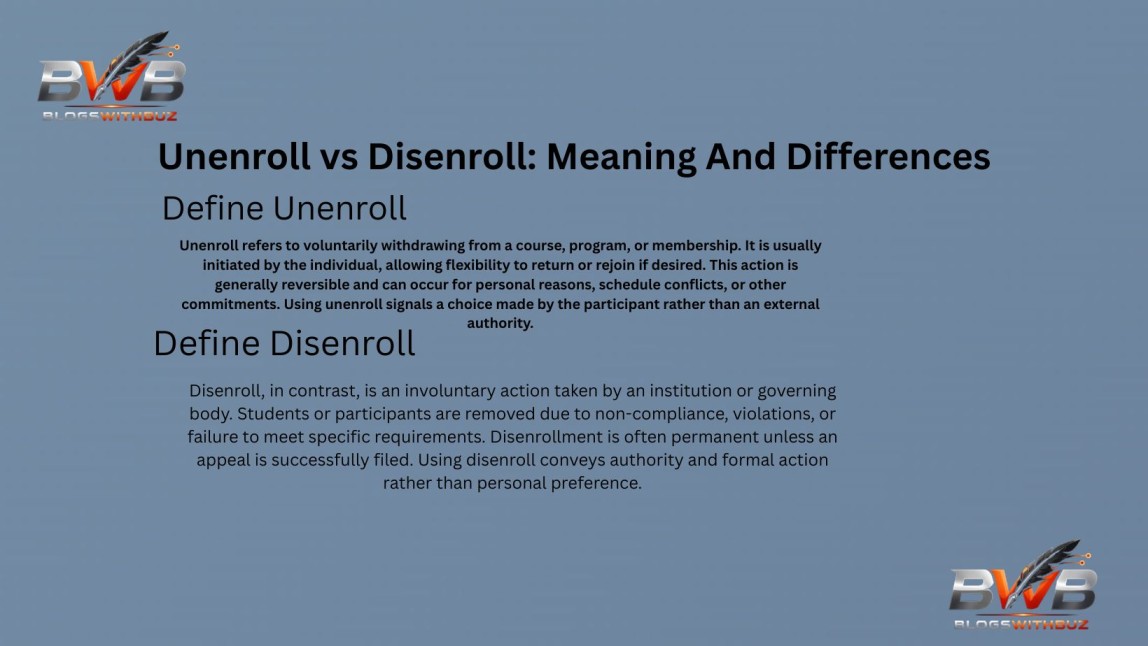
Define Unenroll
Unenroll refers to voluntarily withdrawing from a course, program, or membership. It is usually initiated by the individual, allowing flexibility to return or rejoin if desired. This action is generally reversible and can occur for personal reasons, schedule conflicts, or other commitments. Using unenroll signals a choice made by the participant rather than an external authority.
Define Disenroll
Disenroll, in contrast, is an involuntary action taken by an institution or governing body. Students or participants are removed due to non-compliance, violations, or failure to meet specific requirements. Disenrollment is often permanent unless an appeal is successfully filed. Using disenroll conveys authority and formal action rather than personal preference.
Here is a table to compare the differences between unenroll and disenroll:
| Unenroll | Disenroll |
| Voluntary action | Involuntary action |
| Reversible | Permanent |
| Initiated by individual or authorized party | Initiated by institution or governing body |
How To Properly Use The Words In A Sentence
Proper usage of Unenroll vs Disenroll requires understanding who initiates the action and why. Context is key, whether in academics, healthcare, or technology settings.
How To Use Unenroll In A Sentence
When a student voluntarily removes themselves from a course, unenroll is the correct choice. Examples include:
- She decided to unenroll after realizing the class was not suitable.
- Students can unenroll before the deadline without penalty.
- Personal reasons often lead individuals to unenroll from programs temporarily.
How To Use Disenroll In A Sentence
Use disenroll when an institution removes a participant. Examples include:
- He was disenrolled for failing to meet academic requirements.
- The university may disenroll students violating the code of conduct.
- Disenrolling from the course can affect eligibility for financial aid.
More Examples Of Unenroll & Disenroll Used In Sentences
Understanding examples helps internalize the differences and avoid mistakes.
Examples Of Using Unenroll In A Sentence
- Students must unenroll themselves before the deadline to avoid penalties.
- If you wish, you can unenroll and resume later.
- He chose to unenroll due to financial difficulties.
- Unenrolling from a class removes it from your academic record.
- You may unenroll anytime, but refunds may not apply.
Examples Of Using Disenroll In A Sentence
- The school can disenroll students not meeting requirements.
- After repeated absences, she was disenrolled from the course.
- Failure to pay tuition may result in disenrollment.
- Students disenrolled for misconduct may reapply later.
- Disenrolling affects access to course materials and credits.
Common Mistakes To Avoid
Using The Wrong Term
Using unenroll instead of disenroll or vice versa leads to confusion. Remember, voluntary actions are unenroll, while institutional actions are disenroll.
Assuming The Meaning Is The Same
Many people incorrectly think unenroll and disenroll are identical. Context, reversibility, and authority differentiate them. Always verify before writing or speaking.
Failing To Consider The Context
In healthcare, technology, or academics, the choice varies. For instance, a mailing list unsubscribe is unenroll, but automatic removal from Medicare is disenroll.
Not Following The Correct Procedure
Institutions often require forms or approval. Ignoring the procedure can cause administrative errors, affect financial aid, or delay re-enrollment.
Context Matters
Academic Settings
In schools and universities:
- Students can unenroll voluntarily before deadlines.
- Institutions disenroll for violations, poor performance, or probation.
- Missing deadlines often converts voluntary withdrawal into formal disenrollment.
Healthcare Settings
- Medicare Advantage participants often face disenrollment outside open enrollment.
- Health insurance marketplace users can unenroll informally during open enrollment.
- Automatic removal occurs if eligibility requirements are no longer met.
Technology Settings
- Users may unenroll from newsletters or subscriptions.
- Violations of platform terms can trigger disenrollment.
- Action depends on whether the user initiates or the system enforces it.
Exceptions To The Rules
Automatic Disenrollment
Sometimes, participants are removed without consent due to program closure, relocation, or duplicate enrollment. This is a system-enforced disenrollment.
Exceptions In Healthcare
- Medicaid may disenroll non-paying participants.
- Open enrollment periods allow voluntary unenrollment in some plans.
- Eligibility changes can force automatic institutional removal.
Legal Exceptions
- Certain contracts may prohibit voluntary withdrawal.
- Attempting to unenroll or disenroll improperly could have legal consequences.
- Always review terms before taking action.
Practice Exercises
Exercise 1: Fill In The Blank
Choose the correct word (unenroll or disenroll):
- After failing the course, John decided to ________.
- The student was able to ________ without penalty.
- It is important to ________ before the deadline.
- The university may ________ students violating rules.
Answer Key:
- disenroll
- unenroll
- unenroll
- disenroll
Exercise 2: Sentence Completion
Complete each sentence using either unenroll or disenroll:
- If you decide to ________ from the course, speak with the registrar.
- Students who ________ voluntarily avoid penalties.
- Before you ________, consult the professor.
- It is necessary to ________ before semester end.
Answer Key:
- disenroll
- unenroll
- unenroll
- disenroll
Conclusion
Understanding Unenroll vs Disenroll ensures clear communication. Unenroll is voluntary and reversible, while disenroll is institution-driven and often permanent. Context and proper procedure are crucial. Using these terms correctly prevents misunderstandings, clarifies responsibilities, and helps manage academic, healthcare, or technological enrollments effectively. Awareness of exceptions and proper usage empowers users to make informed decisions and maintain eligibility or compliance across various programs.
Key Takeaways:
- Unenroll vs Disenroll differ in authority, intent, and reversibility.
- Voluntary actions are unenroll, while institutional actions are disenroll.
- Context matters: academic, healthcare, and technology settings vary.
- Follow correct procedures to avoid complications.
- Using these terms correctly improves clarity and professionalism.
FAQs
Is it disenroll or unenroll?
Unenroll is voluntary withdrawal; disenroll is forced by an institution. Context determines correct usage.
What is the difference between disenrolled or unenrolled?
Disenrolled indicates removal by an institution; unenrolled shows voluntary withdrawal by the student.
Can I unenroll or be disenrolled after deadlines?
Deadlines affect reversibility. Voluntary unenroll may be restricted; institutional disenroll follows strict policies.
Does disenrollment affect financial aid?
Yes, being disenrolled can impact scholarships, grants, and eligibility for future programs.
Can unenrollment be reversed?
Yes, voluntary unenroll is usually reversible if requested within institutional guidelines.
Learn the key differences between Unenroll vs Disenroll. Understand voluntary and involuntary withdrawals, examples, mistakes, and proper usage in 2026.
Read more;Blogs With Buz