You should use “son” for permanent or long-lasting qualities and “están” for temporary or changing conditions. In Spanish, both words come from the verbs “ser” and “estar”, which mean “to be”, but they are not interchangeable. Son describes permanent characteristics like nationality, profession, or physical traits. For example, “Ellos son altos” means “They are tall,” highlighting a lasting quality. Están, on the other hand,
describes temporary states, locations, or emotions. For example, “Los niños están cansados” means “The children are tired,” which can change over time. Using the wrong verb can confuse your readers and make sentences sound unnatural. By understanding the difference between ser vs estar, you can write clear Spanish sentences. Practice using son and están in context to improve your grammar, speaking, and overall Spanish proficiency.
Read more spellings:
- Useful vs Usefull: Deciding Between Similar Terms
- Comming Vs Coming: What’s The Correct Spelling To Use?
- Stuck vs Stock: How Are These Words Connected?
- Plating vs Platting: Meaning And Differences
- Challange vs Challenge: When To Use Each One In Writing?
Define Son
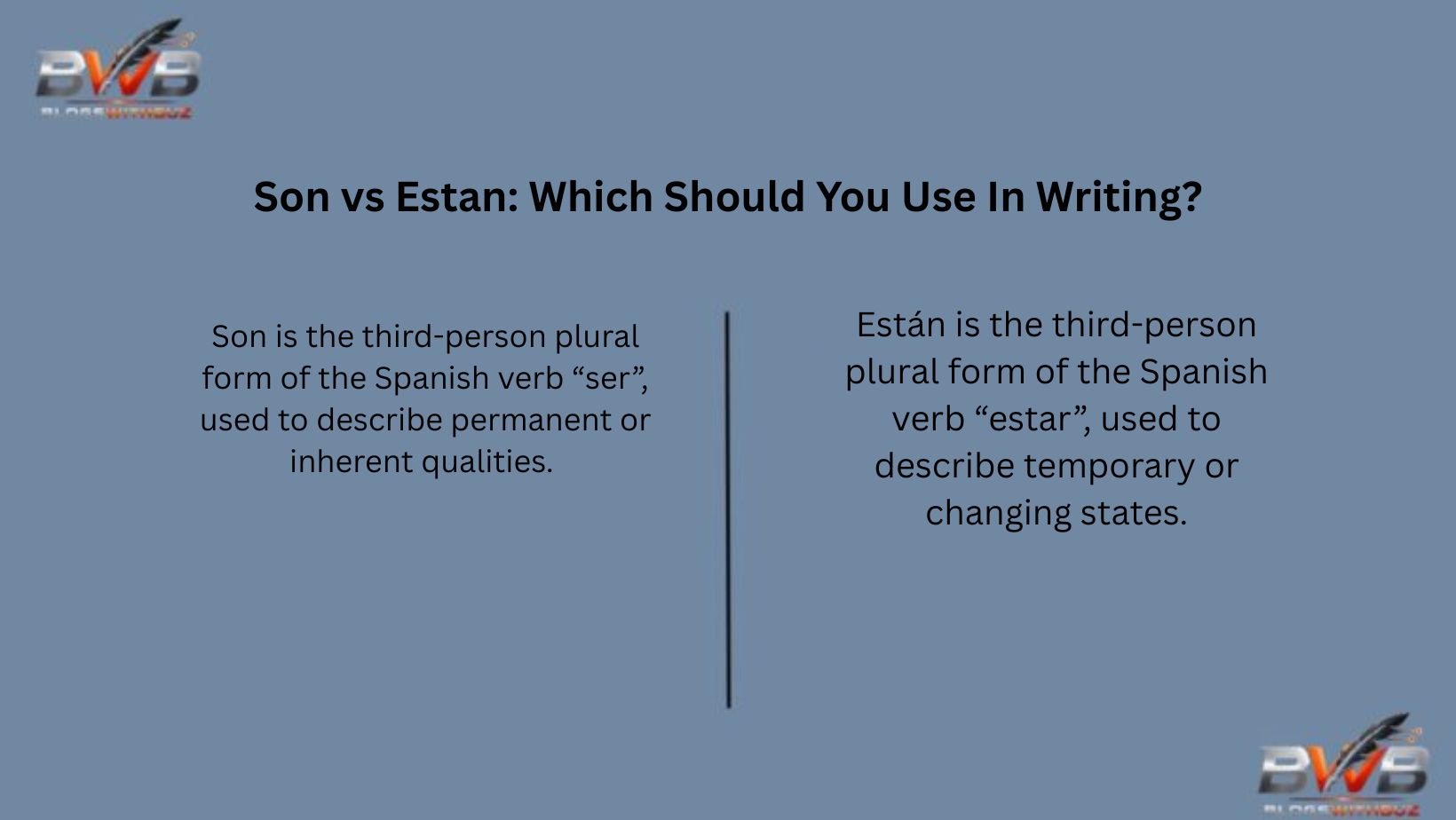
Son is the third-person plural form of the Spanish verb “ser”, used to describe permanent or inherent qualities. You use son to talk about characteristics that do not change, such as nationality, profession, or physical traits. For example, “Ellos son inteligentes” means “They are intelligent.” Son helps convey permanent states, identity, and relationships in Spanish writing and speaking. Understanding the difference between ser vs estar ensures correct usage of son in sentences and improves your Spanish grammar skills.
Define Estan
Están is the third-person plural form of the Spanish verb “estar”, used to describe temporary or changing states. You use están to talk about locations, emotions, conditions, or actions in progress. For example, “Los niños están cansados” means “The children are tired.” Están helps convey temporary situations in Spanish writing and speaking. Understanding the difference between ser vs estar ensures correct usage of están in sentences and improves your overall Spanish grammar and communication skills.
How To Properly Use The Words In A Sentence
Using “son” and “están” correctly depends on whether the quality is permanent or temporary. Understanding ser vs estar helps you write clear Spanish sentences and avoid mistakes.
How To Use “Son” In A Sentence
Use son to describe permanent or lasting characteristics. For example:
- “Los perros son animales inteligentes.” (Dogs are intelligent animals.)
- “Mis amigos son muy divertidos.” (My friends are very funny.)
- “Las flores son hermosas en primavera.” (Flowers are beautiful in spring.)
How To Use “Están” In A Sentence
Use están to describe temporary states, locations, or emotions. For example:
- “Los niños están cansados.” (The children are tired.)
- “Los libros están en la biblioteca.” (The books are in the library.)
- “Mis amigos están en el cine.” (My friends are at the cinema.)
More Examples Of Son & Estan Used In Sentences
Examples of Using “Son” in a Sentence
Use son for permanent or lasting qualities:
- “Los perros son animales domésticos.” (Dogs are domestic animals.)
- “Mis amigos son muy divertidos.” (My friends are very funny.)
- “Las manzanas son rojas o verdes.” (Apples are red or green.)
- “Los niños son juguetones.” (Children are playful.)
- “La música y el baile son importantes en mi cultura.” (Music and dance are important in my culture.)
Examples of Using “Están” in a Sentence
Use están for temporary states, locations, or emotions:
- “Los zapatos están debajo de la cama.” (The shoes are under the bed.)
- “Mis amigos están en el cine.” (My friends are at the cinema.)
- “Los niños están jugando en el parque.” (The children are playing in the park.)
- “Las flores están marchitas.” (The flowers are withered.)
- “Los gatos están durmiendo en el sofá.” (The cats are sleeping on the couch.)
Common Mistakes To Avoid
Even Spanish learners often make mistakes when using son and están. Understanding these errors will help you write and speak correctly.
Mistake #1: Using “Son” To Describe Temporary States
“Son” should not describe temporary conditions. For example, saying “Los plátanos son verdes” is wrong if the bananas are just unripe. The correct sentence is: “Los plátanos están verdes.”
Mistake #2: Using “Están” To Describe Permanent States
“Están” should not describe permanent characteristics. For example, saying “Mi hermana está alta” is incorrect. The correct sentence is: “Mi hermana es alta.”
Mistake #3: Forgetting To Consider Context
Sometimes, the choice depends on context. For instance, “Las manzanas están rojas” is correct if apples are ripe now, but “Las manzanas son rojas” describes their natural color.
Tips To Avoid These Mistakes
- Identify if the quality is permanent or temporary.
- Always consider the context of the sentence.
- Practice son and están in sentences regularly to improve your Spanish grammar.
Context Matters
Understanding the context is key when using son and están in Spanish. Both translate to “are” in English, but their meaning changes depending on the situation. Using the wrong verb can make your sentence confusing.
Usage of Son
Use son to describe permanent or long-lasting qualities, identity, origin, or possession. Examples:
- “Los niños son inteligentes.” (The children are intelligent.)
- “Mi casa y mi coche son rojos.” (My house and my car are red.)
- “Somos de México.” (We are from Mexico.)
Usage of Están
Use están to describe temporary conditions, emotions, or locations. Examples:
- “Los niños están cansados.” (The children are tired.)
- “Mi casa y mi coche están sucios.” (My house and my car are dirty.)
- “Estamos en el cine.” (We are at the cinema.)
Contextual Examples
| Context | Example | Correct Verb |
| Physical Appearance | Las manzanas (are) verdes | Son |
| Taste of Food | Las manzanas (are) deliciosas | Están |
| Location | Mis amigos (are) en la playa | Están |
| Nationality | Mis amigos (are) mexicanos | Son |
Exceptions To The Rules
While most rules for son and están are straightforward, there are some exceptions you should know.
1. Location vs. State
When talking about location, always use están. When describing the state or nature of something, use son.
- “La biblioteca está en la calle principal.” (The library is on Main Street.) → Location
- “La biblioteca es un lugar tranquilo.” (The library is a peaceful place.) → State
2. Temporary Conditions
Use están for temporary conditions and son for permanent characteristics:
- “Hoy estoy enfermo.” (Today I am sick.) → Temporary condition
- “Soy un estudiante de medicina.” (I am a medical student.) → Permanent status
3. Idiomatic Expressions
Some Spanish expressions always use estar or ser:
- “Tener sed” (to be thirsty) → Estar
- “Tener hambre” (to be hungry) → Estar
- “Ser de” (to be from) → Ser
Knowing these exceptions helps you avoid mistakes and use son and están naturally in Spanish.
Practice Exercises
Practicing son and están in sentences will help you master ser vs estar and improve your Spanish grammar and communication skills.
Exercise 1: Choose the Correct Form
Fill in the blank with son or están:
- Los niños ______ en el parque.
- Mi hermana y yo ______ altas.
- ¿Dónde ______ mis zapatos?
- Ellos ______ muy cansados hoy.
- Yo ______ feliz con mi trabajo.
Exercise 2: Complete the Sentence
Complete each sentence with the correct form of son or están:
- Los estudiantes __________ en la clase de español.
- ¿Dónde ___________ mis llaves?
- Mis amigos y yo __________ en el cine.
- Yo ___________ muy emocionado por mi viaje a España.
- ¿Quiénes ___________ los nuevos empleados?
Answer Key:
Exercise 1: están, son, están, están, soy
Exercise 2: están, están, estamos, estoy, son
Regularly practicing these exercises will help you correctly use son and están in context and improve your Spanish writing and speaking skills.
Conclusion
Understanding the difference between son and están is key to writing and speaking correct Spanish. Son is used for permanent or lasting qualities like nationality, profession, or physical traits, while están is used for temporary states, emotions, or locations. By paying attention to ser vs estar, considering context, avoiding common mistakes, and practicing exercises, you can use these verbs naturally. Regular practice will improve your Spanish grammar, writing, and speaking skills.
FAQs
What is the main difference between son and están?
Son describes permanent qualities; están describes temporary states or locations.
Can son and están be used interchangeably?
No, using the wrong verb can cause confusion or incorrect meaning.
When do I use son in a sentence?
Use son for permanent characteristics, identity, nationality, or relationships.
When do I use están in a sentence?
Use están for temporary conditions, emotions, locations, or actions in progress.
How can I practice using son and están correctly?
Practice exercises, examples in context, and paying attention to ser vs estar in everyday Spanish will help you improve.