People mix up safeness and safetyness constantly. Are both real words? Do they mean the same thing?
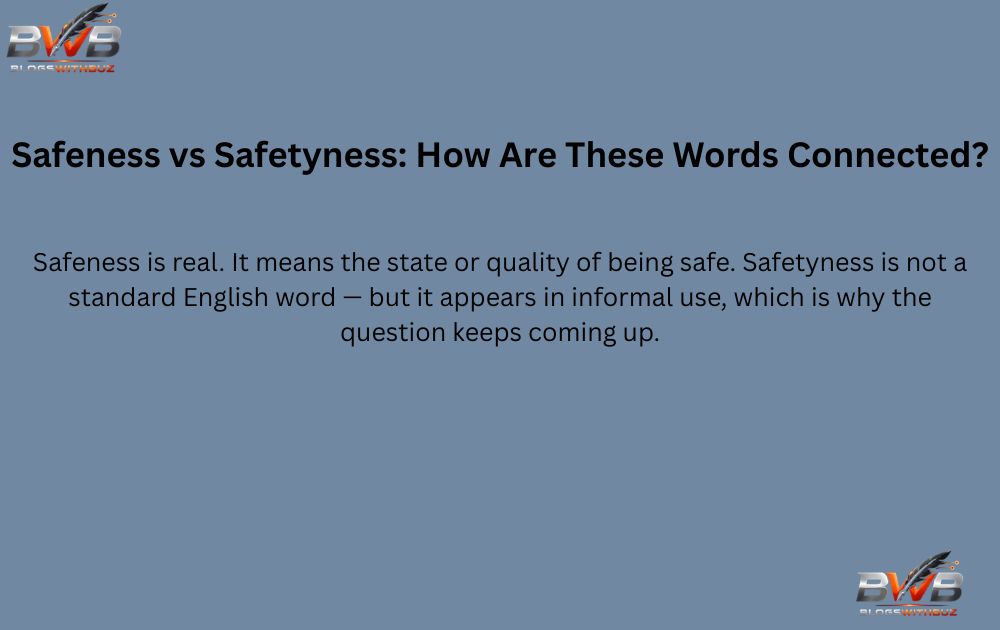
Safeness is real. It means the state or quality of being safe. Safetyness is not a standard English word — but it appears in informal use, which is why the question keeps coming up.
Define Safeness
Safeness is a noun. It describes the condition of being free from harm, danger, or risk. It is an objective term — it refers to measurable, real-world conditions, not feelings.
What safeness typically covers:
- The safeness of a workplace or construction site
- The safeness of a product or medication
- The safeness of equipment or infrastructure
Define Safetyness
Safetyness does not appear in standard dictionaries. It is not formally recognized in English.
Some people use it informally to describe the feeling of being safe — a subjective, emotional sense of security rather than a measurable condition.
If you are writing formally — avoid safetyness entirely. Use safety or safeness instead.
How To Properly Use The Words In A Sentence
How To Use “Safeness” In A Sentence
Use safeness as a noun when describing the state or degree of being safe.
- The safeness of the bridge was tested before it opened to traffic.
- Workers depend on the safeness of their equipment every day.
- The safeness of this medication was confirmed through clinical trials.
- The safeness of the school building was reviewed after the storm.
Quick test: If you can replace safeness with “level of safety” and the sentence still works — you are using it correctly.
How To Use “Safetyness” In A Sentence
Avoid safetyness in formal writing. Where it does appear informally, it tries to express how safe something feels rather than how safe it actually is.
Informal examples:
- “The safetyness of this neighborhood makes me comfortable walking at night.”
- “She appreciated the safetyness of her new work environment.”
In both cases, safety or safeness is the stronger, cleaner choice.
Rule: Every time you are about to write safetyness — replace it with safety. The sentence will always read better.
More Examples Of Safeness & Safetyness Used In Sentences
Examples Of Using Safeness In A Sentence
- The safeness of the amusement park ride was investigated after two complaints.
- Employers are legally responsible for the safeness of the work environment.
- The safeness of bottled water is tested regularly by health authorities.
- Inspectors confirmed the safeness of the electrical wiring in the building.
- The safeness of the new drug was disputed by independent researchers.
- Before buying a used car, always check the safeness of its brakes and tires.
- The safeness of online transactions has improved with two-factor authentication.
- Teachers monitor the safeness of classroom activities as part of their training.
Examples Of Using Safetyness In A Sentence
These show how safetyness appears informally — and why it often sounds awkward:
- The safetyness of the area attracted young families to move there.
- His sense of safetyness grew after the new security cameras were installed.
- Children develop faster in environments where safetyness is a priority.
- Local residents reported low safetyness scores in the community feedback form.
Notice: In every sentence above, replacing safetyness with safety makes the sentence read more naturally and professionally.
Common Mistakes To Avoid
Using Safeness And Safetyness Interchangeably
They are not synonyms.
- Safeness — real, usable noun in formal English
- Safetyness — informal, not in standard dictionaries
Swapping them freely signals careless writing. In professional contexts, always choose safeness or safety.
Offering False Sense Of Security
Using vague safety language to make something sound safer than it is damages your credibility.
- ❌ “This product has great safetyness.”
- ✅ “This product passed three independent safety audits and meets ISO standards.”
Be specific. Vague terms say nothing and trust nothing.
Not Understanding The Meaning Of Safety
Safety is not just the absence of danger. It includes the active steps taken to prevent harm — protocols, inspections, equipment, training.
Thinking “nothing bad has happened, so it is safe” is incomplete. Real safety is built, not assumed.
Tips To Avoid Making These Mistakes
- Use safety as your default word in all contexts.
- Use safeness when you need a noun describing a condition or degree of safety.
- Never use safetyness in formal writing.
- Be specific — explain why something is safe, not just that it is.
- If a sentence uses a safety word without concrete detail behind it, revise it.
Context Matters
Examples Of Different Contexts
| Context | Best Word | Reason |
|---|---|---|
| Workplace / Occupational | Safety or Safeness | Formal, measurable |
| Product descriptions | Safeness or Safety | Objective, verifiable |
| Legal / Regulatory writing | Safety | Required standard term |
| Engineering / Technical | Safeness | Describes degree of protection |
| Healthcare | Safety | Standard clinical language |
| Informal conversation | Any | Clarity over formality |
Match your word to your audience and purpose. A legal document needs precision. A casual conversation has flexibility. A technical report needs the correct noun form.
Exceptions To The Rules
1. Technical Terminology
In engineering and manufacturing, safeness sometimes describes the degree of protection — distinct from “safety” as a general concept.
Example: “The safeness rating of the containment structure exceeds regulatory minimums.”
Here, safeness does precise technical work that the word safety alone does not fully capture. Follow your industry style guide.
2. Regional Differences
- British English — safeness appears more frequently in formal writing.
- American English — safety dominates; safeness is used less but still correctly.
Neither is wrong. Match the conventions of your target audience.
3. Contextual Usage
The sentence structure itself often determines the right choice.
- “The safety measures in the building were inadequate.” — safety as an adjective modifier
- “The safeness of the building was questioned after the earthquake.” — safeness as a standalone noun
Read your sentence out loud. The right word sounds cleaner.
Practice Exercises
Exercise 1
Choose the correct word — safeness or safetyness:
| Sentence | Answer |
|---|---|
| The ____ of the bridge was confirmed by the city inspector. | safeness |
| He felt a sense of ____ in his new apartment. | safetyness (informal only) |
| The ____ of the vaccine was studied over 18 months. | safeness |
Exercise 2
Rewrite using a better word:
| Original | Revised |
|---|---|
| The safetyness of the equipment was verified. | The safeness of the equipment was verified. |
| Employees appreciated the safetyness of their environment. | Employees appreciated the safety of their environment. |
| The safetyness of the product was questioned by regulators. | The safety of the product was questioned by regulators. |
The pattern is clear: safetyness → safety or safeness always produces a cleaner result.
Conclusion
- Safeness — real English word, formal and correct, describes the state or degree of being safe.
- Safetyness — not a standard word, informal only, avoid in professional writing.
- Safety — the most universally accepted term across every context.
Write for your reader, not for word count. Choose the word that communicates your meaning immediately. In almost every situation, that word is safety — and when you need the noun form specifically, safeness is your precise, correct choice.