When reading or writing in English, small differences in spelling can completely change a word’s meaning. A common confusion arises between Manuel Vs. Manual. These two words look similar but have entirely different applications. One is a proper noun, and the other is a common English word used in instructions, machines, and even music. Understanding manual vs manuel correctly can improve your writing, pronunciation, and comprehension. This guide explains their definitions, usage, examples, and key differences to help you avoid mistakes.
Definitions Of Manuel And Manual
To understand manuel or manual, we first need to define both words clearly. Knowing their exact meanings will guide proper usage in sentences and everyday writing.
Definition Of Manuel
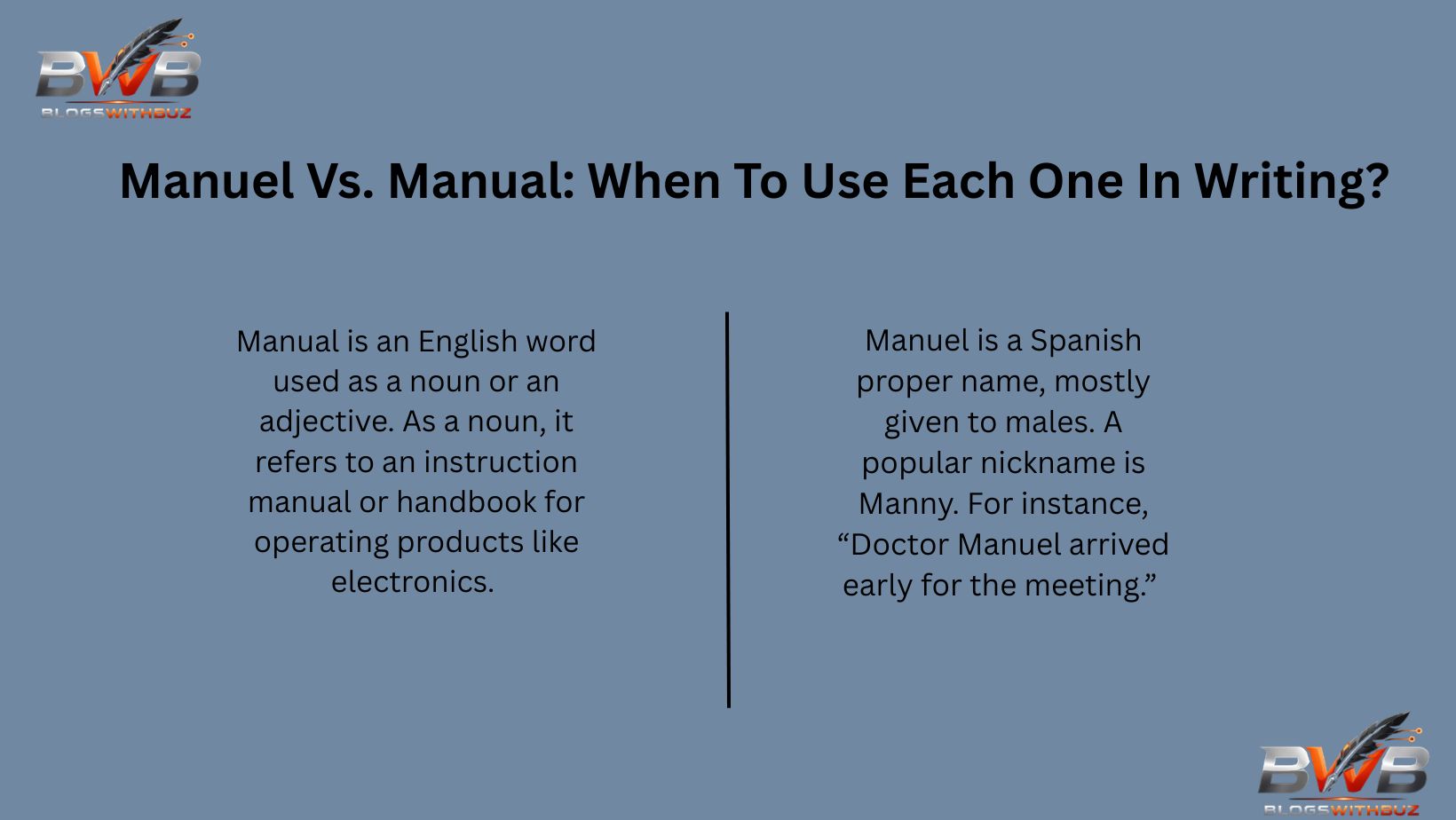
Manuel is a Spanish proper name, mostly given to males. A popular nickname is Manny. For instance, “Doctor Manuel arrived early for the meeting.” Besides being a personal name, Manuel is also the name of a municipality in Valencia, Spain. Locals and tourists alike visit Manuel for its rich culture and scenic spots. Proper nouns like Manuel are always capitalized, and they can appear at the beginning, middle, or end of a sentence depending on their role.
Definition Of Manual
Manual is an English word used as a noun or an adjective. As a noun, it refers to an instruction manual or handbook for operating products like electronics. For example, “Check the manual before using the new device.” In music, manual can also mean a keyboard on instruments like organs.
As an adjective, manual describes something operated by hand, not automatically. For example, “The machine requires manual operation for safety.” Additionally, in automotive contexts, manual transmission refers to vehicles that need gear shifting by the driver, unlike automatic cars. Manual can describe machines, techniques, or processes that rely on human effort.
How To Properly Use Manuel And Manual In A Sentence
Using these words correctly depends on understanding their parts of speech, capitalization rules, and sentence placement. Let’s explore manual or manuel usage in detail.
How And When To Use Manuel
Since Manuel is a proper noun, it always begins with a capital letter. You can place it at the start, middle, or end of a sentence. For example, “Manuel visited the Valencia museum yesterday.” It can act as a subject, direct object, or indirect object. For instance, “We invited Manuel to join our tour,” or “The package was delivered to Manuel.”
When referring to multiple people named Manuel, you can pluralize it in possessive form. Example: “We visited the Manuel’s family during our vacation.” This shows respect to proper noun rules while maintaining clarity.
How And When To Use Manual
Manual is versatile. As a noun, it works for handbooks, guides, or instructions. Example: “Read the instruction manual or Manuel before assembling the furniture.” As an adjective, it emphasizes hand-operated actions: “The manual operations required precise attention.”
In automotive contexts, manual or manuel can be used to discuss cars with gear systems operated by hand. For example, “Learning to drive a manual car is essential before switching to automatic.” Always remember, common nouns like manual are not capitalized unless they start a sentence.
Examples Of Manuel And Manual Use In Sentences
Manuel examples:
- Manuel is a popular tourist destination in Valencia.
- We spent the weekend at Manuel’s house in California.
- Doctor Manuel guided the students during their science project.
- Here is the training manual for the content manager position.
- Do not forget to pass my regards to Mr. Manuel when you arrive in New York.
Manual examples:
- The manual machines cost less than automated ones.
- Please check the instruction manual or Manuel for proper installation.
- Driving a manual car requires practice and patience.
- The instruction manual for the Samsung phone is not as comprehensive as that of the LG phone.
- The Physicists created an automated prototype of the manual jewelry crafting machine.
These examples show clear differences and contextual usage of manuel vs manual, helping writers, students, and professionals distinguish the words.
Conclusion
In conclusion, Manuel Vs. Manual are visually similar but entirely different in meaning and usage. Manuel is a Spanish proper name or a place in Valencia, while manual is an English noun or adjective describing hand-operated objects, instruction guides, or musical keyboards. Correct usage depends on understanding parts of speech, capitalization, and context. By recognizing manual vs manuel, readers can improve grammar, avoid confusion, and communicate more effectively. Remember, pronunciation also differs slightly: manual is “man-yə-wəl” and Manuel is “man-uh-wel,” emphasizing the importance of attention to detail.
Frequently Asked Questions
What is the main difference between Manuel and manual?
Manuel is a proper noun for a person or place, while manual is a noun/adjective describing instructions, hand-operated objects, or processes.
Can Manuel be used as a plural form in writing?
Yes, when referring to multiple people named Manuel, use possessive plural as in “the Manuel’s visited our town.”
How do you pronounce Manuel vs manual correctly?
Manuel is pronounced “man-uh-wel,” and manual is “man-yə-wəl,” with the middle syllable differentiating them.
Is manual only for cars and machines?
No, manual applies broadly: instruction books, hand-operated devices, musical keyboards, and actions performed by humans.
Should I capitalize manual in sentences?
Capitalize manual only at the beginning of a sentence. As a common noun or adjective, it remains lowercase in regular use.
Arial vs Aerial: Clear Differences, Meaning, Usage Guide
Unenroll vs Disenroll: Meaning And Differences
Cryer vs Crier: Differences And Uses For Each One