You are writing an email about your project kickoff meeting and you stop. Should it be kickoff, kick-off, or kick off? All three look right. All three feel right. But they are not the same thing.
Here is the short answer. All three are correct. But each one has a different job. Kickoff is a noun or adjective used in American English. Kick-off is the British English spelling. Kick off (two words, no hyphen) is the phrasal verb, meaning the action of starting something.
In this guide, you will learn exactly when to use each form, what the AP Stylebook says, and how to stop second-guessing yourself every time you write this word.
The Quick Answer, All Three Forms at a Glance
Before we go deep, here is a fast reference table. Save this. You will come back to it.
| Form | Part of Speech | Used In | Example |
| kickoff | Noun / Adjective | American & Canadian English | The kickoff is at 3 PM. |
| kick-off | Noun / Adjective | British English | The kick-off was delayed. |
| kick off | Phrasal Verb | All English varieties | Let us kick off the meeting. |
Now, let me break each one down properly.
What Does Kickoff Mean? (One Word)
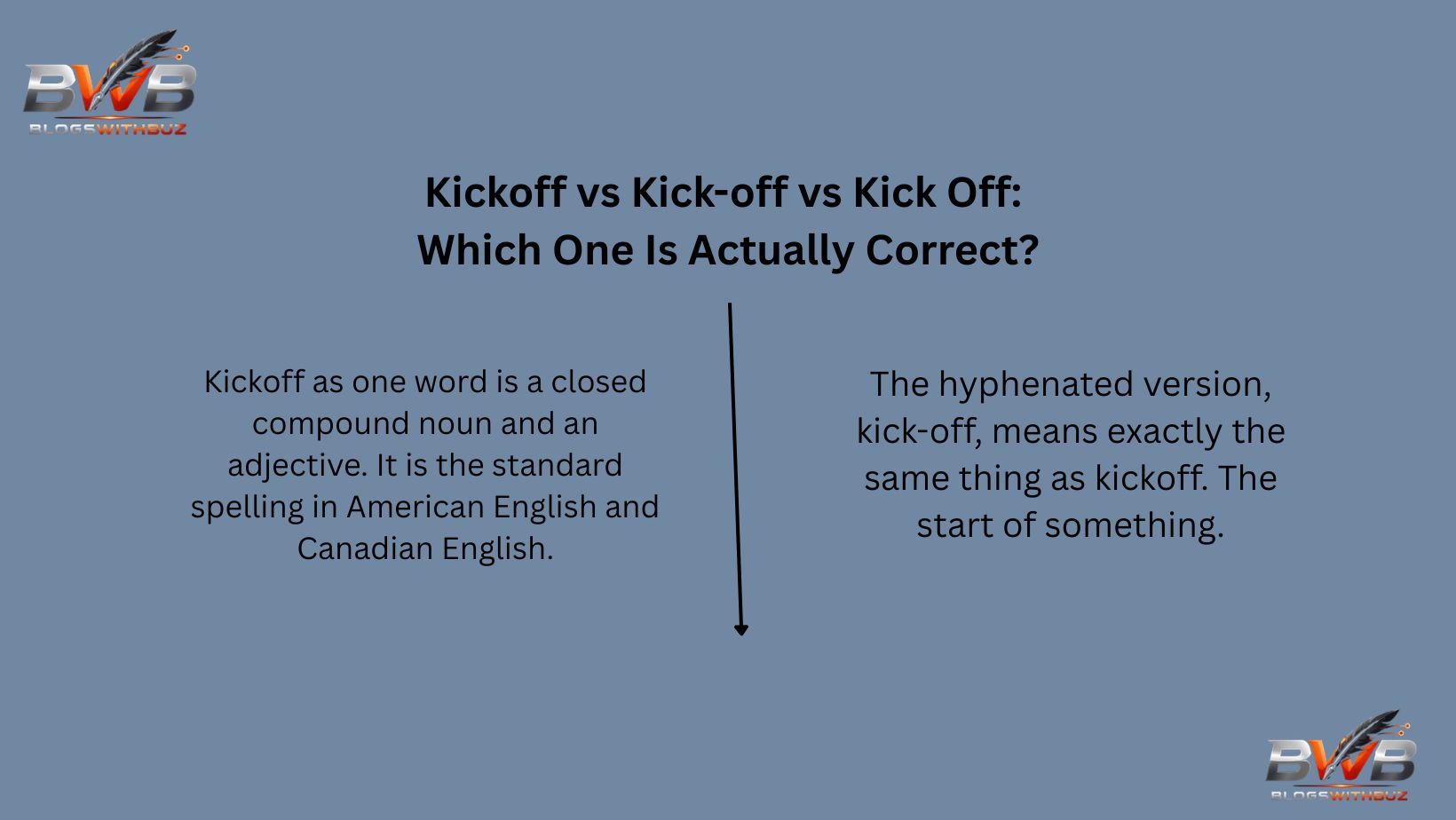
Kickoff as one word is a closed compound noun and an adjective. It is the standard spelling in American English and Canadian English.
It literally means the start of something. The word comes from American football, where one team kicks the ball to start the game. Over time, it moved into everyday business and casual language.
The AP Stylebook, which is the style bible for most American writers and journalists, officially recommends kickoff as the correct one-word spelling for the noun and adjective forms.
Let me show you exactly how to use it.
Kickoff as a Noun
The kickoff for the product launch is set for Monday morning.
We missed the kickoff of the Super Bowl because of traffic.
Kickoff as an Adjective
She organized a kickoff dinner for the new sales team.
The kickoff event drew more than 500 people.
See how in both cases, kickoff is describing a thing or acting as a thing itself. It is not performing an action. That is the key difference.
What Does Kick-Off Mean? (Hyphenated)
The hyphenated version, kick-off, means exactly the same thing as kickoff. The start of something.
But here is the thing. It is mostly used in British English. If you are writing for a UK audience, a British publication, or a global brand with British roots, kick-off is the version you want.
Publications like The Guardian, BBC, and The Times use kick-off regularly. So do many businesses in Australia, New Zealand, and parts of South Asia.
The kick-off meeting starts at 9 AM sharp.
This marks the kick-off point for a much stronger business quarter.
The hyphenated form is slowly fading in some British publications too, with many shifting to the closed compound kickoff. But for now, kick-off is still widely accepted and expected in British writing.
What Does Kick Off Mean? (Two Words, Phrasal Verb)
This one is different from both of the above.
Kick off (two words, no hyphen) is a phrasal verb. It describes the action of starting something. Think of it like other phrasal verbs you already know: log in, follow up, drop off, sign up.
Now here is the interesting part. Kick off also has multiple meanings beyond just starting something.
▶
To start something
We will kick off the campaign on Friday.
✕
To remove someone
They kicked him off the team for missing practice.
👟
To remove shoes
She kicked off her heels the moment she got home.
⚡
To disconnect someone
He got kicked off the server during the live stream.
More Examples of Kick Off as a Verb
The festival will kick off at sundown with a live performance.
Things kick off with the CEO’s keynote address.
City officials wanted to kick off a series of community events.
Notice that in every example above, kick off is doing something. It is an action. That is how you know to use two words with no hyphen.
American English vs. British English, The Real Difference
This is where a lot of writers get confused. And honestly, it makes sense.
In American English, compound words like kickoff are written as one word. You see this pattern everywhere: lineup, rundown, takeoff, kickoff. American writers close the compound.
In British English, many of the same compound words keep their hyphens. So kick-off, line-up, run-down. That is just how the language evolved on each side of the Atlantic.
| Situation | Use This Form |
| Writing for a US audience | kickoff |
| Writing for a UK or global audience | kick-off |
| Writing in Canada | kickoff (follows American style) |
| Using it as a verb (any country) | kick off |
But here is the problem most writers run into. They mix the forms in the same document. One paragraph says kickoff, the next says kick-off. That inconsistency signals carelessness to readers and editors, especially in professional writing.
Pick one and stick with it throughout the entire piece.
What the AP Stylebook and Chicago Manual Say
If you write for American media, marketing, or journalism, you probably follow one of these two style guides.
The AP Stylebook is clear: use kickoff as the noun and adjective, and kick off as the verb. No hyphen needed in American writing.
The Chicago Manual of Style aligns with AP on this. For American English, the one-word compound kickoff is the standard.
The Oxford English Dictionary lists kick-off as the primary British spelling, but also acknowledges kickoff as an accepted variant globally.
The bottom line: always check your company or publication house style guide first. If there is no house style, default to AP for American audiences and Oxford for British ones.
Common Mistakes to Avoid
These are the three errors that show up most often. Even experienced writers make them.
Mistake 1: Using kickoff as a verb
Wrong: We will kickoff the meeting at 10 AM.
Right: We will kick off the meeting at 10 AM.
Mistake 2: Mixing spellings in the same document
Wrong: The kickoff event was great. We plan to do another kick-off next quarter.
Right: The kickoff event was great. We plan to do another kickoff next quarter.
Mistake 3: Using kick-off for a US audience
Wrong (for US readers): Join us for our kick-off webinar on Thursday.
Right (for US readers): Join us for our kickoff webinar on Thursday.
The Simple Rule to Remember Every Time
Ask yourself one question before you write it: Is it a thing or an action?
If it is a thing (noun or adjective), write it as one word: kickoff
If it is an action (verb), write it as two words: kick off
If you are writing for a British audience, use the hyphenated form: kick-off
That is all you need. No more second-guessing.
Real-World Sentence Examples (All Three Forms)
Here are ten examples from real contexts so you can see all three forms doing their job correctly.
- The kickoff for the new product line is scheduled for next Tuesday.
- Let us kick off the brainstorm session with a quick round of introductions.
- Manchester City confirmed the kick-off time for Saturday’s match.
- She planned a kickoff party to celebrate the first day of filming.
- The conference will kick off with a keynote from the founder.
- This kick-off event is expected to set the tone for the entire year.
- Missing the kickoff of the season opener was a big disappointment.
- They decided to kick off the campaign a week earlier than planned.
- Our kickoff meeting covered timelines, budgets, and team responsibilities.
- The tour will kick off in New York before heading to London.
Frequently Asked Questions
Is kickoff one word or two?
It depends on how you use it. As a noun or adjective in American English, it is one word: kickoff. As a verb, it is two words: kick off.
Is “kickoff meeting” or “kick-off meeting” correct?
Both are correct depending on your audience. For American English, use kickoff meeting. For British English, use kick-off meeting.
What does the AP Stylebook say?
The AP Stylebook recommends kickoff as the noun and adjective spelling, and kick off as the verb form.
Can I use kick-off in American writing?
Technically it is not wrong, but it goes against the AP Stylebook standard. American readers and editors expect the one-word form: kickoff.
Is “kick off” an idiom?
Yes. The phrase kick off can be an idiom because its meaning, to start something, is not obvious just from the words kick and off separately.
Practice Exercise: Test What You Have Learned
Fill in the blank with the correct form: kickoff, kick-off, or kick off. Answers are below.
- The team is ready to ________ the new marketing campaign on Monday.
- What time is the ________ for tonight’s game?
- She organized a ________ dinner to celebrate the contract signing.
- The match ________ was delayed by 30 minutes due to rain. (British English)
- We need to ________ the meeting before 9 AM to stay on schedule.
- This is the ________ event of the year, so make sure you attend.
- They got kicked off the platform after violating the terms of service. (Is this correct?)
Answers: 1. kick off 2. kickoff 3. kickoff 4. kick-off 5. kick off 6. kickoff 7. Yes, this is correct.
Final Thoughts
Here is the truth. Most native English speakers write all three forms without thinking. But if you write content for clients, brands, or publications, getting this right matters. It shows you pay attention to detail.
Use kickoff when writing for American or Canadian audiences, whether it is a noun or an adjective.
Use kick-off when writing for British or international audiences in the same roles.
Use kick off as the verb, every single time, no matter what country your audience is in.
That is it. Simple, clear, and easy to remember. Now go write that kickoff email without second-guessing yourself.
Symptomatology vs Symptomology: Meaning And Differences
Litigious vs Litiginous: What is Meaning And Differences Between Them
Shaky Vs Shakey: Differences And Uses For Each One
Safeness vs Safetiness: Meaning And Differences
Emasculate Vs Demasculate, Meaning And Differences