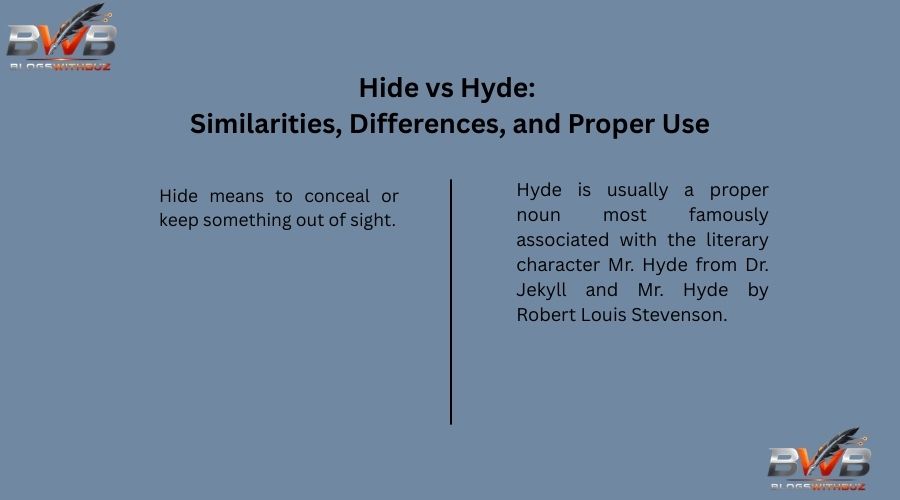
“Hide” and “Hyde” are very different words, and using the wrong one can confuse readers. Hide is a verb that means to conceal something or keep it out of sight. It can also be a noun, referring to the skin of an animal, such as cowhide or sheepskin, used in leatherworking. On the other hand, Hyde is usually a proper noun, most famously from the novel Dr. Jekyll and Mr. Hyde, where it represents a man’s evil alter ego.
People often make spelling mistakes or use these words incorrectly because they sound alike. Understanding the context is key: use hide for invisibility, deception, or concealment, and Hyde only when referring to the literary character or names. By learning the difference and seeing sentence examples, you can avoid confusion and write clearly in English language.
Read more Spellings:
- Shute vs Chute: Understanding Differences, Usage, And Grammar Tips
- Distress vs Duress: Usage Guidelines and Popular Confusions
- Cheer Vs Chear: When To Use Each One? What To Consider
- Pentoxide vs Pentaoxide: Differences And Uses For Each One
- Currier vs Courier: When To Use Each One In Writing?
Define Hide
Hide means to conceal or keep something out of sight. It is a verb when describing actions, like hiding an object, feelings, or oneself from others. Hide can also be a noun, referring to the skin of an animal, such as cowhide or sheepskin, used in leatherworking for clothing, shoes, or accessories. People use hide in contexts like invisibility, deception, or safety, making it a versatile word in the English language. Correct usage ensures clarity in writing and speech.
Define Hyde
Hyde is usually a proper noun most famously associated with the literary character Mr. Hyde from Dr. Jekyll and Mr. Hyde by Robert Louis Stevenson. It represents the evil alter ego or dark side of a person in literature. Unlike hide, it is rarely used as a regular word in the English language. Hyde can also appear as a surname or in place names, but it is important to use it correctly to avoid confusion with the verb hide, which means to conceal or cover something.
How To Properly Use The Words In A Sentence
Using hide and hyde correctly is important to avoid confusion. The two words sound similar but have very different meanings.
How To Use “Hide” In A Sentence
Hide is a verb meaning to conceal or keep something out of sight. It can also be a noun for animal skin like cowhide or sheepskin, used in leatherworking. Examples:
- She likes to hide her diary under the pillow.
- The cat hid under the bed when it was scared.
- The artisan made a wallet from high-quality hide.
How To Use “Hyde” In A Sentence
Hyde is a proper noun, usually referring to the literary character from Dr. Jekyll and Mr. Hyde. Examples:
- Mr. Hyde shows the dark side of Dr. Jekyll.
- The novel Dr. Jekyll and Mr. Hyde is a classic story of duality.
- Hyde can also be a surname or appear in place names like Hyde Park.
More Examples Of Hide & Hyde Used In Sentences
Seeing examples helps understand the difference between hide and hyde.
Examples Of Using Hide In A Sentence
- She tried to hide her disappointment when she didn’t get the job.
- The children played hide and seek in the backyard.
- He decided to hide the truth from his parents.
- The thief hid the stolen items in a nearby dumpster.
- She always hides her insecurities behind a confident look.
- The hikers had to hide from the sudden storm.
- The spy had to hide in plain sight to avoid detection.
- The cat likes to hide under the bed when it’s scared.
Examples Of Using Hyde In A Sentence
- Dr. Jekyll and Mr. Hyde is a classic novel about dual personalities.
- Hyde Park is a popular tourist destination in London.
- The hyde of the cow was used to make leather shoes.
- Hyde was a surname of English origin.
- The evil side of the character, Mr. Hyde, shocked readers.
- Hyde was known for his sharp wit and dark humor.
- The hyde of the snake was shiny and smooth.
Common Mistakes To Avoid
People often confuse hide and hyde because they sound similar. Using the wrong word can change the meaning of a sentence or confuse readers.
Using “Hyde” Instead Of “Hide”
Hyde is usually a proper noun from Dr. Jekyll and Mr. Hyde or a surname. Some people mistakenly write Hyde when they mean hide, the verb for concealing something. For example:
- ❌ She tried to Hyde the gift.
- ✅ She tried to hide the gift.
Using “Hide” Instead Of “Hyde”
Some people incorrectly use hide when referring to the literary character or proper noun. For example:
- ❌ Mr. Hide surprised everyone in the story.
- ✅ Mr. Hyde surprised everyone in the story.
Tips To Avoid These Mistakes
- Remember hide is for concealment, invisibility, or deception.
- Remember Hyde is a proper noun, usually referring to the character in literature or a surname.
- Double-check spelling and context before writing.
- Use sentence examples to confirm correct usage.
Context Matters
Choosing between hide and hyde depends on the context. While they sound similar, they have very different meanings and uses. Understanding the situation is key to using the correct word in your writing or speech.
Examples Of Different Contexts
| Context | Appropriate Word | Explanation |
| Horror literature | Hyde | Refers to the character Mr. Hyde in Dr. Jekyll and Mr. Hyde, representing a dark alter ego. |
| Invisibility | Hide | Refers to concealing yourself or an object from view, e.g., “The chameleon can hide from predators.” |
| Leatherworking | Hide | Refers to animal skin like cowhide or sheepskin used in making leather goods. |
| Deception | Hide | Refers to concealing intentions or feelings, e.g., “She tried to hide her true feelings.” |
Exceptions To The Rules
While the rules for hide and hyde are usually straightforward, there are some exceptions where usage may vary.
Proper Nouns
Proper nouns, such as names of people, places, or characters, often break standard rules. For example:
- Dr. Jekyll and Mr. Hyde is spelled with a “y” in Hyde, even though hide is the common word.
- Some surnames or place names may use Hyde instead of Hide.
Idioms And Colloquialisms
Certain idioms or expressions use hide even if it doesn’t follow the usual rules:
- “Hide your light under a bushel” means to be modest or keep talents private.
- Colloquial phrases often keep hide for meaning, not spelling.
Dialects And Regional Variations
Different English dialects may use hide differently:
- In some regions, hide is commonly used for animal skin, e.g., “cow hide.”
- Regional spelling variations rarely use Hyde unless referring to a proper noun.
Practice Exercises
These exercises will help you use hide and hyde correctly in sentences and understand their proper context.
Exercise 1: Fill In The Blank
Complete the sentences with the correct word: hide or Hyde.
- The spy needed to _____ the secret documents.
- Dr. Jekyll and Mr. _____ are two very different personalities.
- The children decided to _____ and seek in the backyard.
- The artisan crafted a wallet from high-quality _____.
Answer Key:
- hide
- Hyde
- hide
- hide
Exercise 2: Choose The Correct Word
Select the correct word to complete each sentence.
- The treasure was _____ in a secret location. (hide / Hyde)
- Mr. _____ surprised everyone with his dark side. (hide / Hyde)
- She tried to _____ her disappointment after failing the test. (hide / Hyde)
- Hyde Park is a famous tourist destination in London. (hide / Hyde)
Answer Key:
- hide
- Hyde
- hide
- Hyde
Conclusion
Hide and Hyde are two different words with distinct meanings. Hide is a verb for concealing or a noun for animal skin used in leatherworking. Hyde is a proper noun, usually referring to the literary character Mr. Hyde from Dr. Jekyll and Mr. Hyde or as a surname. Using the wrong word can cause confusion, so understanding the context, spelling, and proper usage is important. By practicing with examples, exercises, and context clues, you can confidently use hide and hyde correctly in writing and speech.
FAQs
Can “Hyde” be used as a verb?
No, Hyde is a proper noun. Use hide as a verb to mean conceal.
When should I use “hide” instead of “Hyde”?
Use hide for actions like concealing, invisibility, or deception. Use Hyde only for names or the literary character.
Are there common mistakes with these words?
A3: Yes, people often confuse hide and Hyde because they sound alike. Always check context and spelling.