You’ve typed it both ways. Sometimes it’s one word. Sometimes two. And honestly? Both look right.
But here’s the thing, they’re not the same. And if you’re writing professionally, using the wrong form can quietly hurt your credibility.
So let’s settle this once and for all.
In this guide, you’ll learn the exact difference between healthcare and health care, what major style guides like AP, MLA, and AMA say, when to hyphenate it, and which one you should use depending on your context.
No fluff. Just clear answers.
Healthcare vs Health Care – The Quick Answer
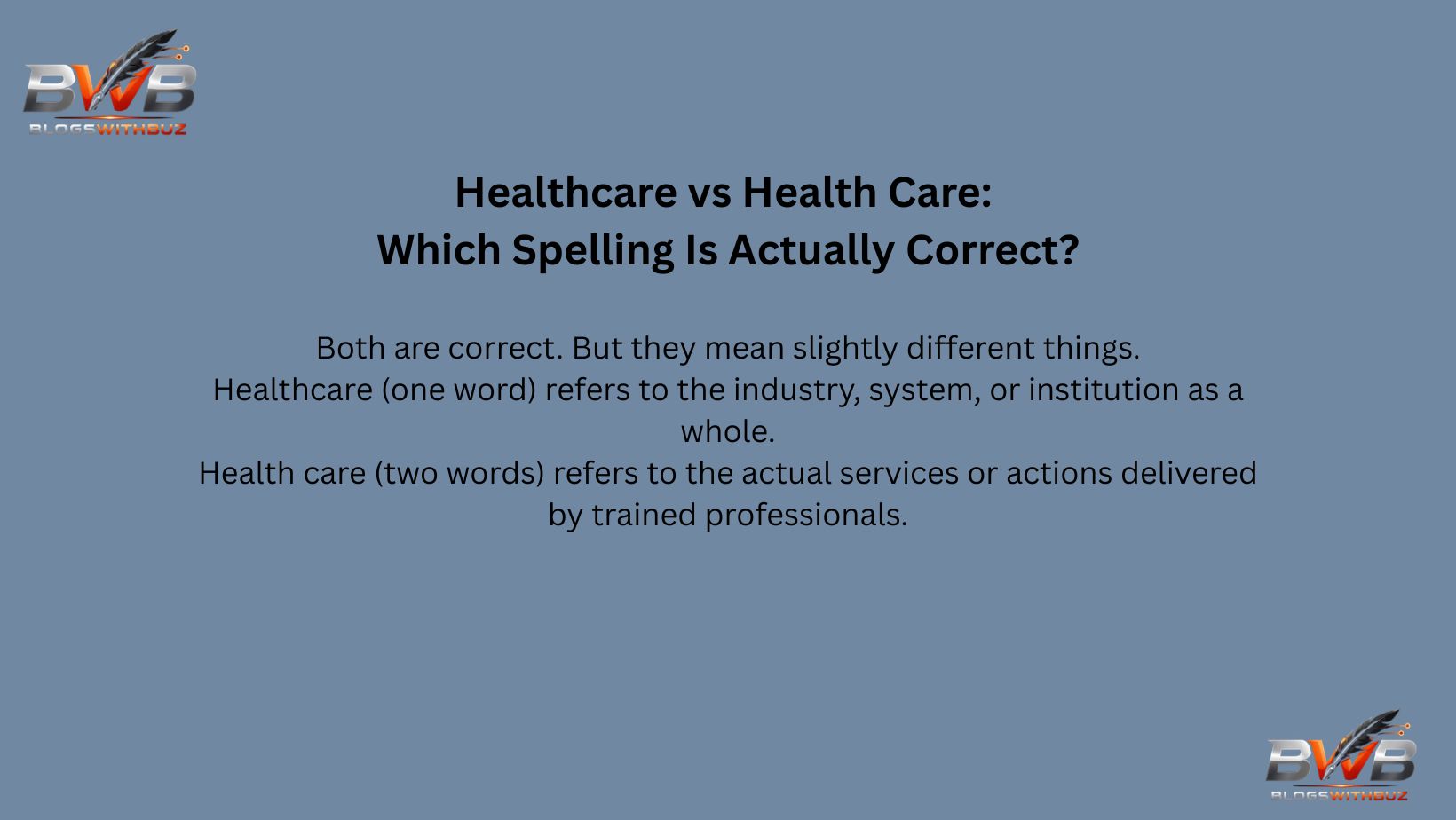
Both are correct. But they mean slightly different things.
Healthcare (one word) refers to the industry, system, or institution as a whole.
Health care (two words) refers to the actual services or actions delivered by trained professionals.
Here’s a simple table to make it stick:
| Term | Form | Best Used For |
| Healthcare | One word | The industry, system, organizations |
| Health care | Two words | Professional actions, patient services |
| Health-care | Hyphenated | Adjective form in MLA style only |
Simple, right? Now let’s go deeper.
What Does “Healthcare” Actually Mean?
Healthcare is a closed compound word.
It describes the broader system, the institutions, organizations, and industries that make medical services available.
Think of it like this:
When you say “she works in healthcare“ , you’re talking about the industry as a whole. Not a specific doctor visit. Not a single treatment. The whole machine.
Healthcare as a noun:
- “The government needs to invest more in healthcare.”
- “She built a career in healthcare management.”
Healthcare as an adjective:
- “The healthcare industry is growing fast.”
- “He applied for a healthcare administration job.”
Here’s the interesting part, healthcare is actually the newer term. The word gained real momentum in 1976 when a major trade publication rebranded to signal that medicine was becoming an industry, not just a service. That one-word form stuck.
What Does “Health Care” Actually Mean?
Health care (two words) is more specific.
It refers to the efforts and actions taken by trained, licensed professionals to maintain or improve a patient’s well-being.
The Merriam-Webster Dictionary defines it as efforts made by professionals to maintain or restore someone’s physical and mental well-being. It’s personal. It’s hands-on. It’s what a nurse, doctor, or therapist actually does.
Health care in action:
- “The health care she received after surgery was excellent.”
- “Preventive health care can save lives.”
- “Access to affordable health care is a basic human right.”
But here’s the problem most writers miss.
When you add a modifier like mental or preventive, two words becomes essential.
Say “mental health care“, and it means care for mental health. ✅
Say “mental healthcare“, and it almost implies the healthcare itself is mental. ❌
That subtle shift in meaning? It matters more than most people realize.
Key Differences: Healthcare vs. Health Care Side by Side
Let me explain this clearly.
Both words look similar. But they serve different purposes in writing.
Scope: Healthcare = the big picture. Systems, policies, industries. Health care = the close-up. Individual services, professional actions, patient-level care.
Grammar role: Healthcare works naturally as both a noun and adjective. Health care works best as a noun only.
You can’t say “the health care industry.” That’s grammatically off. But you can say “the healthcare industry.” That flows perfectly.
Regional use: In the United Kingdom, healthcare (one word) has been the standard for decades. In the United States and Canada, it’s messier, different style guides say different things.
And speaking of style guides…
What Do Major Style Guides Say? (This Is What Most Articles Skip)
This is where it gets really useful.
Because the “right” answer depends entirely on who you’re writing for.
AP Style (Associated Press): AP uses health care as two words, always. Whether you’re talking about the industry or the service. If you’re writing news articles, blogs, or journalism, follow AP. Two words, no exceptions.
MLA Style: MLA also prefers health care as two words when used as a noun. But when it’s an adjective, MLA hyphenates it, health-care costs, health-care reform. This is the only major guide that uses the hyphen form.
AMA Style (American Medical Association): AMA goes the other direction. They prefer healthcare as one word across the board. If you’re writing for medical journals or clinical publications, this is your guide.
NIH (National Institutes of Health): NIH follows AP style, health care, two words, with one big exception. When an organization officially uses one word in its name (like the Agency for Healthcare Research and Quality), you keep their official spelling.
The bottom line?
| Style Guide | Preferred Spelling |
| AP Style | health care |
| MLA Style | health care (noun) / health-care (adjective) |
| AMA Style | healthcare |
| NIH | health care |
| UK Standard | healthcare |
Match your style guide to your audience. That’s the rule.
Is “Health-Care” with a Hyphen Ever Correct?
Yes, but only in one specific situation.
You use health-care (hyphenated) when the word acts as an adjective before a noun, and you’re following MLA style.
Like this:
- Health-care costs are rising.
- Health-care reform has been slow.
- Health-care workers deserve better pay.
But here’s the honest truth, most modern publishers and websites just skip the hyphen completely. They write healthcare costs and healthcare reform as one clean word.
Unless your editor or publication specifically follows MLA, you probably don’t need the hyphen.
American English vs. British English, Who Uses Which?
Now, here’s the interesting part.
The United Kingdom settled this debate long ago. One word: healthcare. Done.
But in America? It’s still a live argument, and it’s driven largely by which industry you work in.
Journalists follow AP → health care Doctors and researchers follow AMA → healthcare Academic writers follow MLA → health care
The trend is shifting though. Online, the one-word form healthcare now appears far more often than the two-word version. Search volume, published books, digital content,all leaning toward one word.
So while the debate isn’t fully settled in the US, the direction is clear.
Is Healthcare Capitalized?
Short answer: No.
Both healthcare and health care are common nouns. You don’t capitalize them in regular sentences.
- ✅ She works in healthcare.
- ❌ She works in Healthcare.
But there’s one exception, proper nouns.
When the word is part of an official organization name, capitalize it exactly as the organization does.
Like these:
- UnitedHealthcare
- Home Health Care, Inc.
- Agency for Healthcare Research and Quality
Always match the official brand spelling. That’s the rule.
Healthcare or Health Care — Which One Should YOU Use?
Here’s the practical guide you actually need.
Writing news or blog content? → Use health care (two words). AP style is the internet standard.
Writing for a medical journal or clinical setting? → Use healthcare (one word). AMA style rules here.
Writing an academic paper? → Use health care (two words), and hyphenate it as an adjective if you’re following MLA.
Writing for a UK audience? → Use healthcare (one word). Always.
Not sure which to follow? → Pick healthcare (one word). It’s the most widely recognized, the most searchable, and it works in nearly every context.
One non-negotiable rule: Whatever you choose, stay consistent throughout your entire piece. Mixing both forms in the same document looks sloppy and confuses readers.
Example Sentences for Both Forms
Healthcare (one word):
- My sister just started her first job in healthcare.
- The healthcare system needs serious reform.
- Modern healthcare combines medicine, technology, and data.
- The company offers strong healthcare benefits to all employees.
Health care (two words):
- Access to affordable health care should be a right, not a privilege.
- Preventive health care reduces long-term costs for everyone.
- The health care she received at the clinic was outstanding.
- Mental health care has become more accessible through telehealth.
See how that works? One is about the system. The other is about the service.
Frequently Asked Questions
Is healthcare one word or two?
Both are correct. Use healthcare (one word) for the industry or system. Use health care (two words) for the services and actions of professionals.
What does AP Style say about healthcare?
AP Style uses health care as two separate words in all cases, noun or adjective.
Is health care the same as healthcare?
Not exactly. They overlap in casual use, but healthcare refers to the broader system while health care refers to professional actions and services.
When should I use health-care with a hyphen?
Only when following MLA style and using the word as an adjective, like health-care costs or health-care reform.
Is healthcare capitalized?
No. It’s a common noun. Only capitalize it when it’s part of a proper organization name.
Final Word: Which One Wins?
Here’s the honest answer. Neither one is universally “right.” Context, audience, and style guide are what make the call.
But if you’re writing for the web, for American readers, or for a general audience? Healthcare (one word) is your safest, most versatile choice.
It’s cleaner. It’s searchable. And it works whether you’re using it as a noun or an adjective.
Just remember the one exception, when you add a modifier like mental or preventive, always go with two words to keep the meaning crystal clear.
Now you know. Go write with confidence.
Meny vs Many: When to Opt for One Term Over Another
Seak vs Seek: Decoding Common Word Mix-Ups
Plushie or Plushy: When to Opt for One Term Over Another
Waring vs Wearing: The Main Differences And When To Use Them