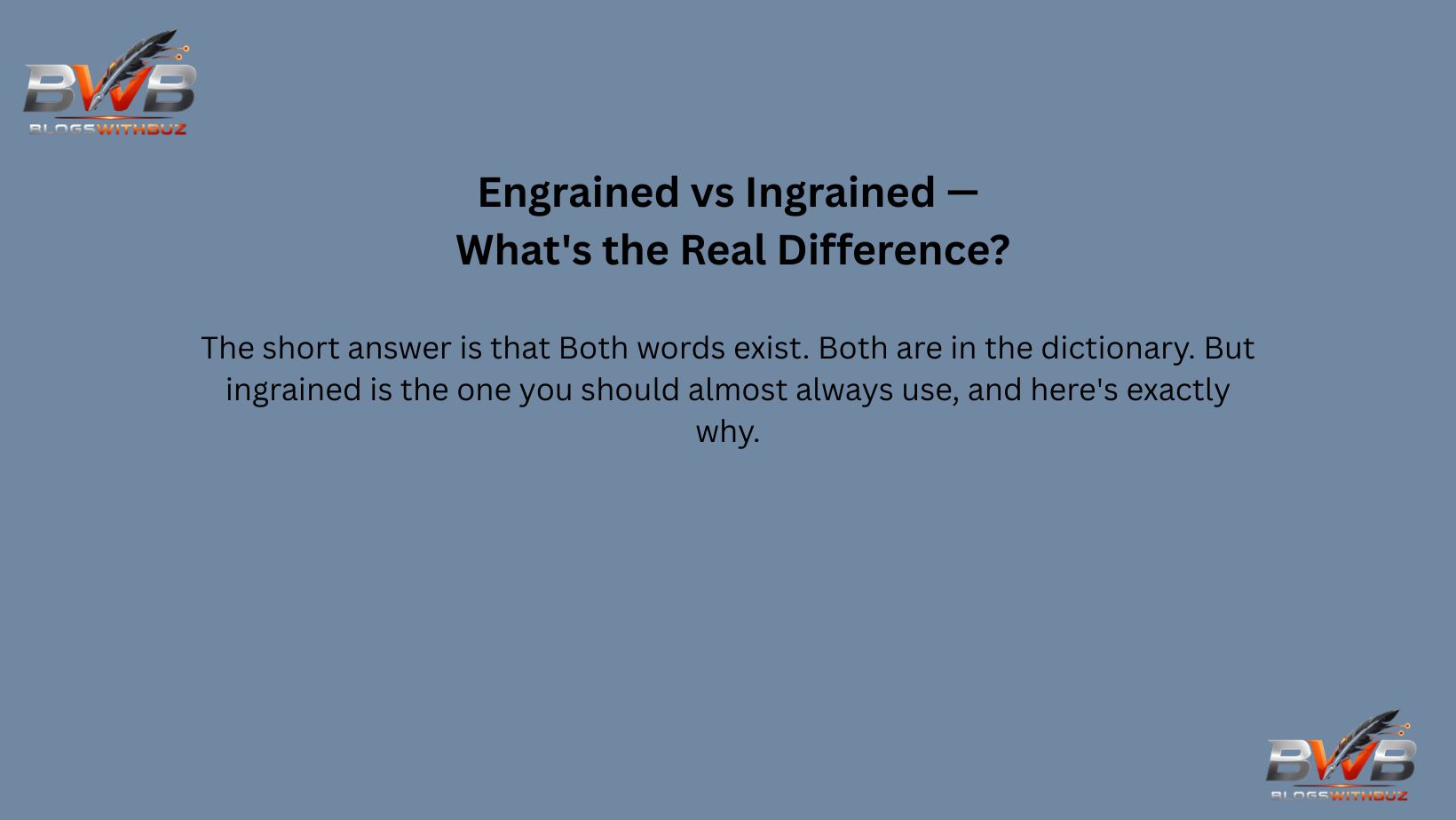
The short answer is that Both words exist. Both are in the dictionary. But ingrained is the one you should almost always use, and here’s exactly why.
If you’ve ever paused mid-sentence wondering whether to write engrained or ingrained, you’re not alone. It’s one of those spelling questions that looks simple on the surface but hides a surprising amount of history underneath.
This article breaks it all down. The meanings, the differences, the history, common mistakes, and a simple trick to make sure you never mix them up again.
What Does Ingrained Mean?
Ingrained means something deeply fixed, firmly established, and very hard to change.
We use it most often for habits, beliefs, attitudes, and behaviors. Things that have been part of a person — or a culture — for so long that they feel automatic. Almost impossible to shake.
Let me explain with a few examples:
- His fear of failure was deeply ingrained from childhood.
- Respect for elders is an ingrained part of our culture.
- Ingrained habits are the hardest ones to break.
Notice the pattern? Ingrained almost always refers to something mental or emotional. A belief. A mindset. A tradition. Something you can’t see or touch but that runs deep.
Now here’s the interesting part — the word has a fascinating origin.
Where Does Ingrained Come From?
The word goes back centuries. It comes from the phrase “dyed in grain” — a reference to fabric that was colored so deeply, so permanently, that the dye became part of the material itself. You couldn’t wash it out.
Over time, that physical idea of “permanently dyed” turned into a metaphor. Something ingrained in a person is like that permanent dye — it’s not going anywhere.
That origin story also explains why engrained exists. Both spellings grew from the same root.
What Does Engrained Mean?
Here’s where most articles get it wrong — and it matters.
Engrained does not have a separate, different meaning from ingrained.
Some writers claim engrained is for physical things (like dirt in a carpet) and ingrained is for mental things (like habits). But that’s not accurate. Major dictionaries — Merriam-Webster, Oxford, and Cambridge — all list engrained simply as a variant spelling of ingrained. Same meaning. Different spelling.
Engrained is just the older, rarer form. It shows up more in older texts and British English. In modern writing — especially in American English — it’s almost never used.
So if someone tells you engrained means something physically embedded while ingrained means mentally embedded, they’re drawing a distinction that doesn’t hold up in real usage or in any major dictionary.
Engrained vs. Ingrained — Side-by-Side Comparison
| Ingrained | Engrained | |
| Meaning | Deeply fixed or established | Same meaning |
| Spelling status | ✅ Preferred modern spelling | ⚠️ Older, rarer variant |
| American English | Always preferred | Rarely seen |
| British English | Still preferred | Occasionally used |
| Dictionary listing | Primary entry | Listed as variant |
| Recommended for writing? | Yes | Not unless you have a reason |
The bottom line? Ingrained is always the safer, smarter choice.
Ingrain vs. Engrain — The Verb Forms
Both words also have verb forms. And the same rule applies here.
Ingrain (verb) means to establish something deeply and firmly — especially a habit, belief, or value — in a person or group.
- Parents try to ingrain good values in their children from a young age.
- The coach worked hard to ingrain discipline in every player.
Engrain (verb) is the older alternative. Same meaning. Much less common.
- He wanted to engrain a sense of responsibility in his students.
Use ingrain in modern writing. It’s cleaner, more widely understood, and more standard.
American English vs. British English — Does It Matter?
Yes, a little.
In American English, ingrained is overwhelmingly dominant. You’ll rarely see engrained in US publications, newspapers, or academic writing.
In British English, engrained pops up slightly more often — but even there, ingrained is the clear standard.
If you’re writing for a US audience, there’s really no debate. Go with ingrained, every time.
Major style guides like AP Style and Chicago Manual of Style don’t make a specific ruling on this pair — but both default to standard dictionary spelling, which means ingrained wins by default.
Common Mistakes People Make
But here’s the problem — there are a few mix-ups that come up again and again with these words.
Mistake 1: Thinking they have different meanings. They don’t. Ingrained and engrained mean the same thing. The only difference is spelling preference.
Mistake 2: Using engrained in formal or academic writing. It’s not wrong, technically. But it will look unusual to editors and readers in the US. Stick with ingrained.
Mistake 3: Confusing ingrained with engraved. These are completely different words. Engraved means physically carved or etched into a surface — like a name engraved on a trophy. Ingrained is about deeply fixed habits or beliefs. One is physical. One is mental.
Mistake 4: Overusing the phrase “deeply ingrained.” It’s a common phrase, but it gets overused. Mix it up with synonyms like deep-seated, entrenched, hardwired, or rooted to keep your writing fresh.
Synonyms for Ingrained (Use These Too)
Using varied language helps your writing and also improves how search engines and AI tools read your content. Here are strong alternatives:
For habits and behaviors:
- Deep-seated — a deep-seated fear of rejection
- Entrenched — entrenched workplace habits
- Hardwired — hardwired responses to stress
- Instilled — values instilled in childhood
For beliefs and attitudes:
- Rooted — deeply rooted cultural beliefs
- Inveterate — an inveterate skeptic
- Inherent — an inherent distrust of authority
- Fixed — a fixed mindset
All of these words carry the same core idea — something that runs deep and doesn’t change easily.
Real-World Example Sentences
Here’s ingrained used correctly across different contexts:
Psychology & Mental Health:
- His ingrained response to conflict was to shut down completely.
- Therapists often work to identify and challenge ingrained thought patterns.
Culture & Society:
- Ingrained gender roles still shape expectations in many workplaces.
- The ingrained tradition of hospitality defines how guests are welcomed in the region.
Parenting & Education:
- She worked hard to ingrain a love of reading in her kids before they started school.
- The school’s values became ingrained in students long after graduation.
Business & Leadership:
- A culture of ingrained complacency can be the death of any organization.
- The best leaders ingrain accountability into every level of the team.
And here’s engrained — used correctly, in a context where the older spelling fits:
- The text was so old, the letters were nearly engrained into the stone.
- The word “honour” appeared engrained in the traditions of the old institution.
How to Remember Which One to Use ingrain vs engrain
Here’s a simple trick that actually works.
Think of the word “in” — as in inside. Ingrained things live inside you. Inside your mind. Inside your culture. Inside your habits.
And remember: ingrained is in the dictionary as the preferred form.
So whenever you’re writing about beliefs, habits, behavior, culture, or mindset — the answer is always ingrained. No second-guessing needed.
FAQ — Quick Answers
Is engrained a real word?
Yes. It’s a valid but rare alternative spelling of ingrained. Both are in major dictionaries.
Which is correct — ingrained or engrained?
Both are technically correct, but ingrained is the standard modern spelling. Use it.
What does ingrained mean?
Something firmly established and very hard to change — usually habits, beliefs, behaviors, or cultural attitudes.
Is it “deeply ingrained” or “deeply engrained”?
Deeply ingrained is the correct, widely accepted phrase. Avoid deeply engrained in modern writing.
What’s the difference between ingrained and embedded?
Embedded usually means something physically placed inside something else. Ingrained is used for deeply fixed habits or mental attitudes.
Can you use ingrained for physical things?
Mostly no. Ingrained is used figuratively. For physical objects, use embedded, fixed, or set into.
Final Word
Here’s what you need to take away from this.
Ingrained and engrained are not two different words with two different meanings. They’re the same word with two different spellings, and one of those spellings (ingrained) has completely taken over in modern English.
The next time you’re writing about habits that are hard to break, beliefs that run deep, or cultural traditions that have stuck around for generations, the word you want is ingrained.
Simple. Clear. Always correct.
Waring vs Wearing: The Main Differences And When To Use Them
Bright vs Brite: Meaning And Correct Use For Each Word
Useful vs Usefull: Deciding Between Similar Terms
Comming Vs Coming: What’s The Correct Spelling To Use?
Stuck vs Stock: How Are These Words Connected?