If you have ever stopped mid-sentence wondering whether to write auxiliary or auxillary, you are not alone. This is one of those spelling mistakes that trips up even confident writers. The two words look nearly identical, and that is exactly why so many people get confused.
The good news is the answer is simple. Only one of them is real. Once you understand which one is correct and why, you will never mix them up again. Let’s walk through everything clearly.
Define Auxiliary
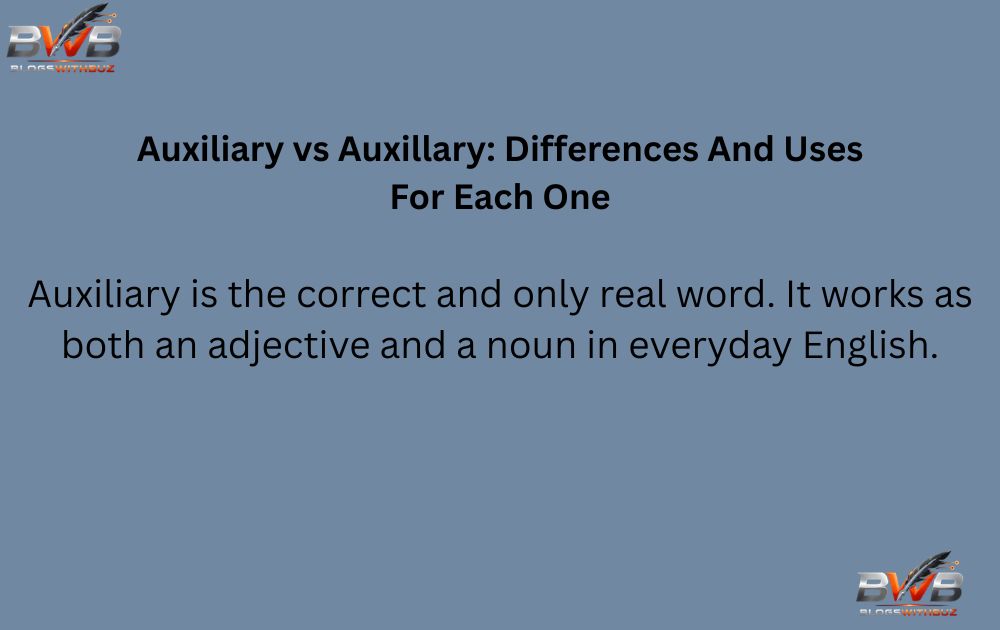
Auxiliary is the correct and only real word. It works as both an adjective and a noun in everyday English.
As an adjective, it describes something that gives extra or supplementary help to something main. As a noun, it refers to a person or thing that acts as a backup or provides additional support.
Think of it this way, anything that steps in to help when the main thing needs assistance is auxiliary. In grammar, an auxiliary verb is a helper verb. Words like “is,” “was,” “have,” and “do” are auxiliary verbs. They help the main verb show verb tenses, moods, and voices. They also help form questions and form negatives in sentences.
For example:
- “She is running.” — here “is” is the auxiliary verb.
- “They have finished.” — here “have” is the auxiliary verb.
The word comes from Latin auxilium, simply meaning help. Over time, it became a standard word used across medicine, engineering, military, and grammar.
Quantify vs Qualify: Key Differences You Must Understand Today
Unaffected vs Uneffected: Which Word To Use Correctly In Writing
Giddy vs Gitty: Understanding Differences, Meanings, And Proper Usage
Mopping vs Moping: Differences Meaning Usage Examples and Common Mistakes
Safeness vs Safetyness: How Are These Words Connected?
Provider vs Providor: Deciding Between Similar Terms
Define Auxillary
Auxillary is not a real word. It does not exist in the English language. It is purely a misspelling of auxiliary.
People write auxillary because the word auxiliary has an unusual ending. The “-iary” part does not follow the spelling patterns most people are used to, so they accidentally write “-illary” instead. It is a very common word confusion, but it is still wrong.
Whenever you see auxillary written somewhere, it is a mistake. The correct spelling is always auxiliary no exceptions.
How To Properly Use The Words In A Sentence
Knowing the correct spelling is just the first step. You also need to know how to place the word naturally inside a sentence. Here is a simple breakdown.
How To Use Auxiliary In A Sentence
Auxiliary always describes something secondary that supports something primary. It can describe people, machines, systems, or verbs. Here are some easy examples:
- The auxiliary nurse helped the doctor throughout the long surgery.
- When the lights went out, the auxiliary power source kept everything running.
- The army called in an auxiliary unit to back up the main troops.
- The auxiliary engine started automatically when the main one broke down.
- She used an auxiliary cable to connect her phone to the speakers.
Notice the pattern in every sentence, the auxiliary thing is the helper, the backup, or the extra support. That is the core idea behind this word.
How To Use Auxillary In A Sentence
Since auxillary is a misspelling, you should never use it in a sentence. Any sentence with auxillary is automatically wrong. Here are a few corrected examples:
- ❌ “The auxillary battery died.” ✅ “The auxiliary battery died.”
- ❌ “They sent an auxillary team.” ✅ “They sent an auxiliary team.”
- ❌ “The auxillary cord stopped working.” ✅ “The auxiliary cord stopped working.”
Simple fix every time — just replace auxillary with auxiliary.
More Examples Of Auxiliary & Auxillary Used In Sentences
More examples always help. Here is a wider list so you can see how naturally auxiliary fits into real sentences.
Examples Of Using “Auxiliary” In A Sentence
- The auxiliary camera recorded all the behind-the-scenes moments during filming.
- Firefighters used an auxiliary fuel tank to travel longer distances without stopping.
- The auxiliary police managed traffic control during the busy road closure.
- An auxiliary heat source kept the building warm during the long power outage.
- He plugged his laptop into the auxiliary input on the sound system.
- The mechanic fixed the broken auxiliary fuel pump to restore full engine power.
- The auxiliary motor gave the small boat extra push through rough water.
- Doctors prescribed auxiliary medication to reduce the patient’s pain alongside main treatment.
- The auxiliary battery kept the security system active during the blackout.
- The auxiliary bishop led the church service in place of the main bishop.
Every single example shows something giving extra help or acting as a backup that is always the right context for this word.
Examples Of Using “Auxillary” In A Sentence
These are wrong sentences with corrections so you can spot the error easily:
- ❌ “The auxillary nurse worked the night shift.” ✅ “The auxiliary nurse worked the night shift.”
- ❌ “We installed an auxillary pump to improve water pressure.” ✅ “We installed an auxiliary pump to improve water pressure.”
- ❌ “The auxillary unit secured the area.” ✅ “The auxiliary unit secured the area.”
- ❌ “She took auxillary treatment alongside her main medicine.” ✅ “She took auxiliary treatment alongside her main medicine.”
Always catch and correct auxillary before publishing or submitting anything important.
Common Mistakes To Avoid
Even good writers make mistakes. Here are the most common ones related to auxiliary vs auxillary so you can avoid them easily.
Highlighting Common Mistakes
The most common mistake is writing auxillary instead of auxiliary. It happens because the correct spelling feels unusual. Most people write what sounds familiar, and doubling the “l” feels natural but it is wrong.
Another mistake is using auxiliary when a simpler word like additional or extra would work better. Auxiliary specifically means something that supports a main function. It is not just a fancy word for “more.” For example, “She gave some auxiliary ideas during the meeting” sounds awkward. “She gave some additional ideas” is much cleaner and clearer.
Writers also sometimes misuse auxiliary verbs by treating them as standalone complete sentences. “She is” without a main verb leaves the reader confused. Always pair an auxiliary verb with a main verb for the sentence to make sense.
Tips For Avoiding Mistakes
Always run a spell check, but do not rely on it fully. Some spell checkers may not catch auxillary because it resembles a real word closely enough to slip through.
Keep a trusted dictionary or thesaurus nearby. Checking takes seconds and protects your professional writing from embarrassing errors.
Make proofreading a habit. Reading your work aloud helps you catch mistakes your eyes skip over during silent reading.
When unsure, choose a simpler, familiar word instead. Clear and simple writing always beats complicated and incorrect writing.
Context Matters
The meaning of auxiliary stays the same, but the way it is used shifts depending on where you are using it. This word is truly context-dependent.
Examples Of Different Contexts
In grammar, auxiliary refers to helper verbs that support the main verb. These include “do,” “have,” “will,” “is,” and “was.” They shape verb tenses, moods, and voices in sentences.
In engineering, auxiliary describes secondary equipment that backs up primary equipment. An auxiliary engine, auxiliary motor, or auxiliary fuel pump all exist to step in when the main system needs support.
In medicine, an auxiliary nurse or auxiliary treatment means extra care given alongside the main plan. Hospitals depend heavily on auxiliary staff during busy periods.
In the military, an auxiliary unit supports frontline forces with supplies, logistics, or crowd control duties. Auxiliary police also assist regular officers with traffic control and public safety.
Understanding the right context helps you use the word correctly every time.
Exceptions To The Rules
Technical Terminology
In some older engineering and technical documents, you might come across auxillary used as a specific technical term for certain secondary equipment. This was not always a mistake — it was sometimes an accepted industry variant. However, modern technical terminology standards have moved on. Today, auxiliary is the accepted form even in engineering and technical fields.
Regional Differences
There are minor regional differences worth knowing. Older British English texts occasionally used auxillary as an alternative spelling. However, both British English and American English now follow the same standard auxiliary is correct, and auxillary is not. So no matter where you are writing from, always use auxiliary.
Historical Usage
From a historical usage standpoint, the Oxford English Dictionary once listed auxillary as an accepted variant spelling. Centuries ago, English spelling was not standardized the way it is today. Many words had multiple accepted spellings. Over time, auxiliary became the dominant and correct form, while auxillary faded into being a simple misspelling. Today, no modern style guide accepts it.
Practice Exercises
The best way to lock in what you have learned is to test yourself. Try these quick exercises.
Exercise 1:
Look at each sentence and decide correct or incorrect?
| Sentence | Answer |
| The auxillary nurse helped during surgery. | Incorrect |
| The auxiliary engine powered the backup system. | Correct |
| She used an auxillary cord to connect her phone. | Incorrect |
| The auxiliary unit supported the main troops. | Correct |
Exercise 2:
Fill in the blank with the right word:
- The _______ power source kept the hospital running during the storm. ✅ auxiliary
- He connected his phone using an _______ cable. ✅ auxiliary
- The _______ bishop delivered the Sunday sermon. ✅ auxiliary
- The _______ fuel tank helped the plane fly much farther. ✅ auxiliary
If you got all four right, you have completely mastered auxiliary vs auxillary.
Conclusion
Key Takeaways
Auxiliary is always the correct spelling. It means something that provides extra help or backup support. Auxillary is simply a misspelling it has no place in correct writing. Whether you are writing about grammar, medicine, engineering, or everyday topics, always use auxiliary. A quick habit of proofreading and checking a dictionary will protect your writing every time. Good spelling reflects clear thinking, and clear thinking builds trust with every reader you write for.
FAQs
What is the correct spelling — auxiliary or auxillary?
Auxiliary is always correct. Auxillary is a common misspelling with no valid meaning in modern English grammar or any professional writing context.
What does auxiliary mean in grammar?
An auxiliary verb supports the main verb to show tense, mood, or voice. Common examples include “is,” “have,” “do,” and “will” used daily.
Is auxillary ever acceptable in any situation?
Historically it appeared in older texts, but today auxillary is universally treated as a misspelling. Always use auxiliary in any modern writing context.
What are common real-life examples of auxiliary?
Examples include auxiliary nurse, auxiliary engine, auxiliary power source, auxiliary cable, and auxiliary police all describing helpful backup roles or things.
Why do writers keep misspelling auxiliary as auxillary?
The “-iary” ending feels unusual, so writers naturally double the “l” out of habit. Awareness of this pattern helps you catch and fix the mistake easily.