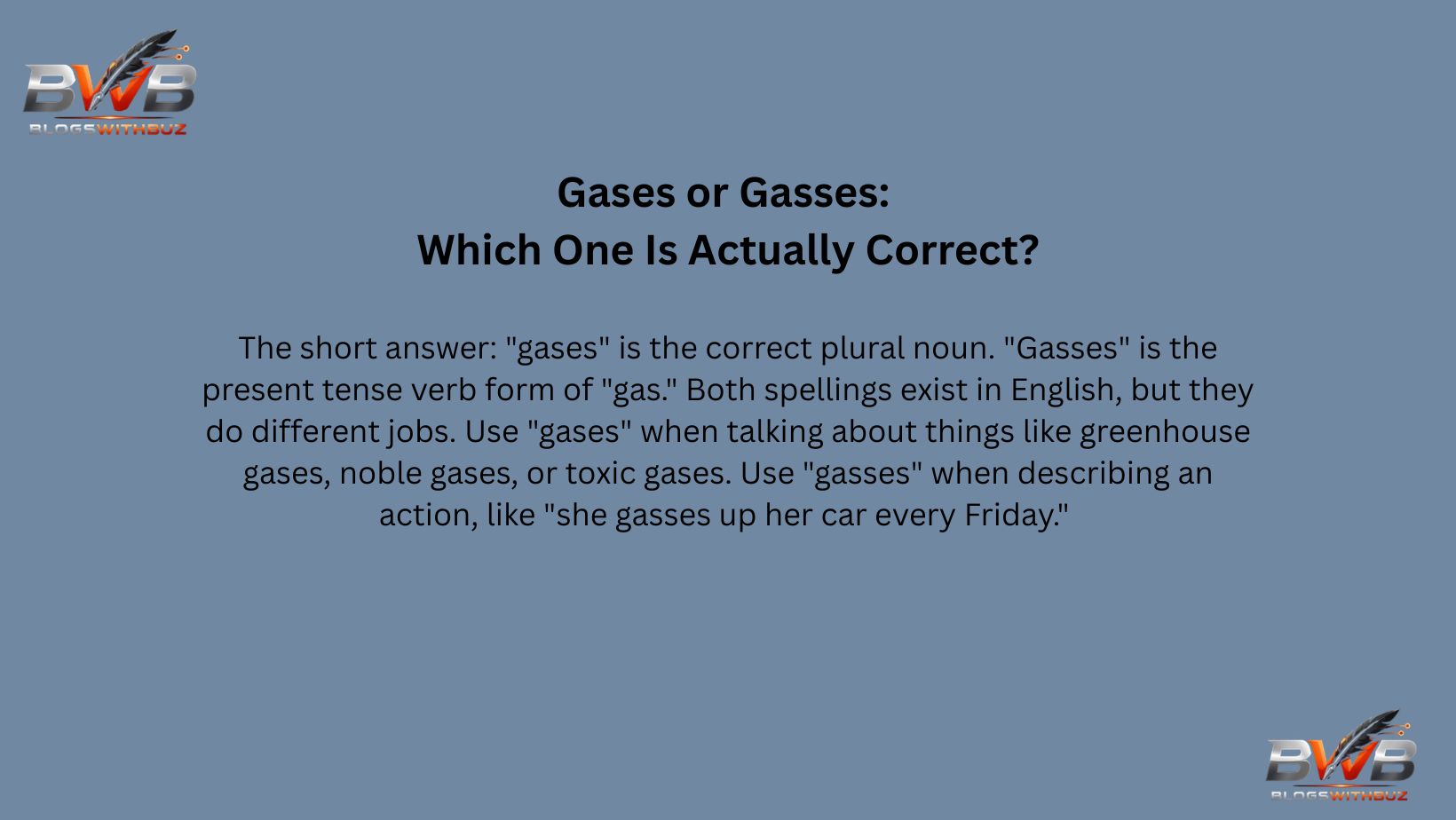
The short answer: “gases” is the correct plural noun. “Gasses” is the present tense verb form of “gas.” Both spellings exist in English, but they do different jobs. Use “gases” when talking about things like greenhouse gases, noble gases, or toxic gases. Use “gasses” when describing an action, like “she gasses up her car every Friday.” Most people get this wrong. This article will make sure you never mix them up again.
Why Do People Get This Wrong in the First Place?
Let me explain.
When you add “-es” or “-ed” to a word ending in a consonant, English often doubles that consonant.
Think about it: “nag” becomes “nagged.” “Bar” becomes “barred.”
So it feels natural to write “gasses” as the plural of gas.
But here is the thing. That doubling rule exists to protect the short vowel sound. It stops “bared” (long vowel, like in bare) from getting confused with “barred” (short vowel, like in bar).
Now, here is the interesting part.
“Gase” is not a real word. Nobody reads “gases” and thinks it sounds like “gazes.” So there is no confusion to protect against. That is why the plural stays as “gases,” not “gasses.”
Simple. But knowing the reason makes it stick in your head for good.
What Does “Gases” Mean? (And When Should You Use It?)
“Gases” is the plural form of the noun “gas.”
Gas, as a noun, has two main meanings in English:
First meaning: A state of matter. Gas is one of the four states of matter, alongside solid, liquid, and plasma. A gas has no fixed shape and no fixed volume. It expands to fill whatever container it is in.
Second meaning: Gasoline. In American English, “gas” is the informal word for fuel used in cars and trucks.
Both meanings use “gases” as the correct plural.
Here are some real examples:
- Noble gases like helium, argon, and neon are used in lighting and welding.
- Greenhouse gases trap heat in the atmosphere and drive climate change.
- Toxic gases like carbon monoxide are colorless and odorless, which makes them especially dangerous.
- The only gases available at that station are premium and regular unleaded.
- Scientists study atmospheric gases to understand air quality and pollution.
Now, here is a stat that makes this even clearer.
According to Garner’s Modern English Usage, “gases” as the plural noun appears at a ratio of 42 to 1 compared to “gasses.” That is how dominant “gases” is in real-world writing, science, journalism, and publishing.
So if you are writing about chemistry, climate science, or everyday fuel, always go with gases.
What Does “Gasses” Mean? (The Verb Form)
But here is the problem most people miss.
“Gasses” is not just a misspelling. It is actually a real word. It is the third-person singular present tense of the verb “to gas.”
What does the verb “gas” mean? It has three different uses:
1. To fuel a vehicle with gasoline:
- “She gasses up the car every Friday before the weekend road trip.”
2. To expose something or someone to gas:
- “The exterminator gasses the pest problem in a controlled and safe way.”
3. To excite or impress someone (informal slang, mostly in British and Irish English):
- “That performance gasses me up every single time.”
So “gasses” is doing real work as a verb. It is not a mistake. It is just being used in a specific grammatical situation.
The full verb conjugation of “to gas” looks like this:
- Present (third person singular): gasses
- Past tense: gassed
- Present participle: gassing
Now you can see clearly why both spellings exist and why they serve different purposes.
Gases vs. Gasses: Side-by-Side Comparison Table
| Gases | Gasses | |
| Part of speech | Noun (plural) | Verb (3rd person present) |
| Primary use | Plural of gas | Action performed by a subject |
| Example sentence | Noble gases are used in lasers. | She gasses up before long trips. |
| Used in science? | Yes, always | Rarely |
| Correct as plural? | Yes, always preferred | Acceptable but uncommon |
| Correct as a verb? | No | Yes, always |
Save this table. It is the fastest way to check which spelling you need.
Gasses or Gases in Scientific Writing? (This One Matters)
If you write about science, environment, or health, this section is for you.
In scientific and academic writing, “gases” is always the correct choice. No exceptions.
You will see this consistently across every major style guide, scientific journal, and professional publication:
- Greenhouse gases (not greenhouse gasses)
- Noble gases (not noble gasses)
- Toxic gases (not toxic gasses)
- Inert gases (not inert gasses)
- Flue gases (not flue gasses)
The Intergovernmental Panel on Climate Change (IPCC), NASA, and every major chemistry textbook uses “gases.” If you use “gasses” in a science paper or article about climate change or air quality, it will look like a spelling error to your readers.
This is one of the most common mistakes in environmental writing. Many writers type “greenhouse gasses” without thinking. But the correct term is “greenhouse gases,” every single time.
American English vs. British English: Is There a Difference?
Great question. And the answer is simple.
No. There is no regional difference here.
Unlike “colour vs. color” or “organise vs. organize,” the gases vs. gasses distinction is not about where you are from. Both American English and British English use “gases” as the standard plural noun. Both use “gasses” as the third-person verb form.
This is not a British thing or an American thing. It is purely about what the word is doing in the sentence, which is a part of speech thing.
So wherever you are in the world, the rule is the same.
Stuck vs Stock: How Are These Words Connected?
Plating vs Platting: Meaning And Differences
Three Memory Tricks That Actually Work
Now, here is the fun part.
You will never mix these up again after learning one of these.
Memory trick 1: “Double S means doing something”
“Gasses” has a double S. Verbs are about doing things. Double S, doing something. If you are describing an action, gasses is your word.
Memory trick 2: “Masses of gases”
Need the plural noun? Think of the phrase “masses of gases.” Both end in the same sound. One S, not two. Gases rhymes with masses, cases, and places. All nouns, all one S.
Memory trick 3: Swap the word
Not sure which to use? Replace “gas” with another noun. Try “liquid.”
- “The room was full of toxic liquids.” (noun, plural)
- “The room was full of toxic gases.” (noun, plural) ✓
If the swap works as a noun, use gases. If the sentence is about an action, use gasses.
Common Writing Mistakes (With Quick Fixes)
Let me show you the exact mistakes writers make, so you can spot and fix them fast.
Mistake 1: ❌ “The buildup of greenhouse gasses is accelerating global warming.” ✅ “The buildup of greenhouse gases is accelerating global warming.”
Mistake 2: ❌ “Noble gasses are found on the far right of the periodic table.” ✅ “Noble gases are found on the far right of the periodic table.”
Mistake 3: ❌ “Toxic gasses filled the abandoned building after the chemical leak.” ✅ “Toxic gases filled the abandoned building after the chemical leak.”
Mistake 4: ❌ “She gases up the car twice a week.” ✅ “She gasses up the car twice a week.” (Here it is a verb, so double S is correct.)
See the pattern? When in doubt, ask yourself: am I talking about things, or about an action?
Things, use gases. Action, use gasses.
FAQ: Gases or Gasses (People Also Ask)
Is “gasses” ever correct as a plural noun?
Yes, it can technically be used as a plural of “gas,” but it is not preferred. “Gases” is the standard plural in all formal, scientific, and professional writing. “Gasses” as a plural looks like an error to most readers, even if it is technically acceptable.
What is the plural of gas in chemistry and science?
Always “gases.” Whether you are talking about noble gases, ideal gases, inert gases, or atmospheric gases, the correct plural in every scientific context is gases with one S.
Can “gases” ever be used as a verb?
No. “Gases” is always a noun. If you want the verb form in the third person present tense, you always need “gasses.”
Why do so many people write “greenhouse gasses” by mistake?
Because the doubling-consonant rule in English feels intuitive. When people add a suffix to a short word ending in a consonant, doubling feels right. They apply that instinct to the noun plural too, even though it does not apply here.
Which spelling does Google prefer?
For search and content purposes, both terms exist as search queries. But the dominant, high-authority spelling in published content is “gases.” Writing “greenhouse gases” aligns with every major scientific source, which builds content credibility.
Quick Summary: The Rule in One Sentence
Use “gases” as the plural noun for things, and “gasses” as the verb when someone is performing an action involving gas.
That is it. One simple rule.
- Greenhouse gases, noble gases, toxic gases (noun plural, one S)
- She gasses up the car, the exterminator gasses the area (verb, double S)
If you get those two situations straight, you will never make this mistake again.
Practice Exercise: Test Yourself; Gases vs Gasses
Read each sentence below. Decide whether the blank should be filled with “gases” or “gasses.”
Try them before looking at the answers.
Sentences:
- Carbon dioxide and methane are both ______ that contribute to the greenhouse effect.
- My dad always ______ up the truck on Sunday nights before the work week.
- Scientists have identified over a dozen ______ in the upper atmosphere that affect ozone levels.
- The heating engineer warned us that certain ______ can be extremely flammable.
- Every morning, the city bus ______ up at the central depot.
- The experiment showed that some ______ react differently under high pressure.
- She ______ her friends up every time she tells that story.
- Volcanic eruptions release a mix of ______ including sulfur dioxide and carbon dioxide.
Answers:
- Gases (plural noun, things in the atmosphere)
- Gasses (verb, he performs the action of fueling)
- Gases (plural noun, scientific context)
- Gases (plural noun, talking about types of gas)
- Gasses (verb, the bus performs the action)
- Gases (plural noun, scientific experiment)
- Gasses (verb, informal meaning to excite or impress)
- Gases (plural noun, geological and scientific context)
Want to keep improving your writing? Check out related articles on commonly confused words like “Challange vs Challenge“, and “Signer Vs Signor.”