The simple answer is this: a plushie is a stuffed toy, while plushy usually describes something soft and fluffy. People often mix these words, but they have slightly different uses in everyday English.
A plushie refers to a soft stuffed animal or plush toy made from plush fabric and filled with soft stuffing. Children and collectors love plushies because they look cute and feel cuddly. For example, a teddy bear, bunny, or unicorn toy can be called a plushie.
On the other hand, plushy usually works as an adjective. It describes something that feels soft, thick, and comfortable. People may talk about a plushy carpet, plushy blanket, or plushy pillows.
Understanding the difference between plushie and plushy helps you use the right word in the right context. If you talk about a stuffed animal toy, say plushie. If you describe a soft texture, use plushy. This small grammar detail makes your writing clearer and easier to understand.
Check more spellings:
Bearable vs Bareable: When To Use Each One In Writing?
Tie Vs Tye: Understanding Correct Usage and Common Mistakes
Commit vs Comit: Correct Spelling And Usage In English Writing
Incall vs Outcall: Decoding Common Word Mix-Ups
Eccentric vs Eclectic: Differences And Uses For Each One
Define Plushie
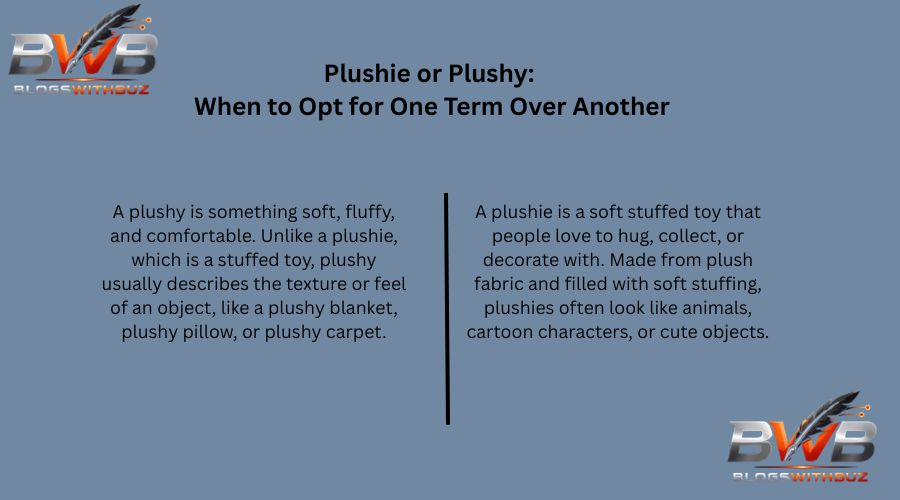
A plushie is a soft stuffed toy that people love to hug, collect, or decorate with. Made from plush fabric and filled with soft stuffing, plushies often look like animals, cartoon characters, or cute objects. Kids enjoy playing with plushies, while collectors display them on shelves or beds. Examples include teddy bears, unicorns, or plush dinosaurs. Using the word plushie correctly helps describe a cuddly stuffed animal toy clearly in everyday English and online communities.
Define Plushy
A plushy is something soft, fluffy, and comfortable. Unlike a plushie, which is a stuffed toy, plushy usually describes the texture or feel of an object, like a plushy blanket, plushy pillow, or plushy carpet. It can also describe soft and rounded shapes, such as plushy cushions or even a cuddly stuffed animal’s texture. Using plushy correctly helps convey comfort and softness in everyday English, making your writing clear when you want to describe something cozy, gentle, or smooth to touch.
How To Properly Use The Words In A Sentence
Using plushie and plushy correctly depends on their meaning. Plushie is a noun that refers to a soft stuffed toy, while plushy is an adjective that describes something soft, fluffy, or comfortable. Knowing this difference helps you write clearly and avoid confusion. Always use plushie when talking about a cuddly stuffed animal and plushy when describing the texture or softness of an object.
How To Use “Plushie” In A Sentence
- My daughter loves to collect plushies of different animals.
- She hugged her plushie tightly while watching a movie.
- The toy store sells a variety of plushie dinosaurs and unicorns.
- I bought a new plushie for my niece’s birthday.
How To Use “Plushy” In A Sentence
- The couch cushions were so plushy and comfortable.
- She wrapped herself in a plushy blanket on the cold night.
- The hotel room had a plushy bed and soft pillows.
- His teddy bear had a plushy texture that felt very soft.
More Examples Of Plushie & Plushy Used In Sentences; is it plushy or plushie?
Using plushie and plushy in different sentences helps you see their meaning clearly. Here are more examples for everyday use.
Examples Of Using Plushie In A Sentence
- My nephew collects plushie dinosaurs and displays them on his shelf.
- She received a plushie unicorn as a gift from her best friend.
- The children were excited to get plushie toys at the birthday party.
- I sewed my own plushie using a pattern I found online.
- His favorite plushie was a soft and cuddly bunny.
Examples Of Using Plushy In A Sentence
- The living room carpet felt plushy under my feet.
- He received a plushy robe as a gift from his aunt.
- Her bedroom was decorated with plushy pillows and blankets.
- The spa offered plushy robes and slippers for all guests.
- The car’s interior was made with plushy leather seats.
Common Mistakes To Avoid
Many people confuse plushie and plushy, using them interchangeably. This can create confusion because plushie is a noun for a soft stuffed toy, while plushy is an adjective describing something soft, fluffy, or comfortable. Using them incorrectly may make your writing unclear, especially when talking about toys, furniture, or soft objects.
Using “Plushie” And “Plushy” Interchangeably
A common mistake is writing sentences like:
- “I bought a plushy teddy bear” (incorrect if you mean a stuffed toy).
- “The carpet is full of plushies” (incorrect if you mean soft and fluffy).
Remember: plushie = stuffed toy, plushy = soft/fluffy texture. Mixing them can confuse your readers.
Tips For Avoiding These Mistakes
- Use plushie only for stuffed animals or plush toys, like teddy bears, unicorns, or cartoon plushies.
- Use plushy as an adjective for soft or comfortable items, such as blankets, pillows, carpets, or cushioned chairs.
- Check the context: if you describe a toy, write plushie; if you describe texture or softness, write plushy.
- Keep sentences simple and clear to make your meaning obvious.
Following these tips ensures your writing about plush toys and soft items is correct, readable, and easy to understand.
Context Matters
Choosing between plushie and plushy depends on the situation. Understanding the context helps you use the right word and makes your writing clear. Remember, plushie refers to a stuffed toy, while plushy describes softness or comfort.
Examples Of Different Contexts
- Toy Industry: Companies and stores often use plushie to describe stuffed animals or collectible plush toys, like teddy bears, unicorns, or dinosaur plushies.
- Casual Conversation: People might use either word depending on preference. A child may call their favorite stuffed animal a plushie, while someone else might describe a soft pillow as plushy.
- Home Decor: Use plushy when talking about furniture or soft items, like plushy cushions, blankets, or carpets.
- Formal Writing: In articles or reports, plush is often preferred for formal descriptions, but you can use plushie when specifically mentioning toys.
Exceptions To The Rules
Although plushie and plushy usually follow clear rules, there are some exceptions. Understanding these helps you use the words correctly in all situations.
1. Regional Differences
In different regions, the words may have slightly different meanings. For example, in British English, plushie usually refers to a soft toy, while plushy describes something luxurious or soft, like a plushy sofa or carpet.
2. Brand Names
Some companies use plushie or plushy as part of their brand names, regardless of grammar rules. For instance, a toy brand may sell “Plushies” as a proper noun. In these cases, the word is a name, not a description.
3. Personal Preference
Some people simply prefer one word over the other. For example, a collector may always say plushie, while someone else uses plushy casually to describe the same toy.
4. Contextual Usage
Sometimes, context changes the meaning. If you are talking about the softness of fabric used in a toy, plushy may be more appropriate than plushie, even when referring to a toy.
5. Cultural Differences
In some cultures, like Japan, plushies are tied to kawaii (cute) culture and are often collectible items. Here, using plushie emphasizes the cultural and collectible aspect rather than just softness
Practice Exercises
To better understand the difference between plushie and plushy, try these exercises. They help you use the words correctly in sentences.
Exercise 1: Fill In The Blank
Choose the correct word (plushie or plushy) to complete each sentence:
- My little sister loves to cuddle with her ______ teddy bear.
- After the carnival, I won a ______ unicorn at the ring toss.
- My mom collects vintage ______ toys from the 80s.
- At the toy store, the shelves were lined with ______ animals of all shapes and sizes.
- During the movie, I snuggled up with my ______ penguin.
Answer Key:
- plushie
- plushy
- plushie
- plushie
- plushy
Exercise 2: Sentence Rewrites
Rewrite the following sentences using plushie or plushy correctly:
- The child clutched his stuffed animal tightly.
- She received a soft toy as a gift from her grandmother.
- The new store specializes in stuffed animals.
- He won a prize at the fair, a soft toy.
Answer Key:
- The child clutched his plushie tightly.
- She received a plushy as a gift from her grandmother.
- The new store specializes in plushies.
- He won a plushy at the fair.
Conclusion
In simple terms, both plushie and plushy are related to soft and cuddly items, but they serve different purposes. A plushie is a stuffed animal or toy, while plushy describes something soft, fluffy, or comfortable, like pillows, blankets, or carpets. Using these words correctly depends on context, audience, and personal preference. Avoid mixing them to keep your writing clear. By understanding their meanings and practicing examples, you can confidently describe stuffed toys, plush fabrics, and cozy items in everyday English. Choosing the right word makes your sentences precise, engaging, and easy to understand.
Key Takeaways
- Plushie is a noun that refers to a soft stuffed toy, like teddy bears, unicorns, or cartoon plushies.
- Plushy is an adjective used to describe soft, fluffy, or comfortable items, such as pillows, blankets, carpets, or cushioned chairs.
- Avoid using plushie and plushy interchangeably to prevent confusion in writing or conversation.
- Context matters: choose plushie when talking about toys, and plushy when describing texture, comfort, or coziness.
- Understanding the difference helps you write clearly, accurately, and naturally in everyday English and online communities.
Frequently Asked Questions (FAQs)
What is the difference between plushie and plushy?
A plushie is a soft stuffed toy, while plushy describes something soft, fluffy, or comfortable, like pillows, blankets, or carpets.
Can plushie and plushy be used interchangeably?
No. Using them interchangeably can confuse readers. Plushie refers to toys, while plushy describes softness or texture.
How do I use plushie in a sentence?
Example: “My daughter hugged her favorite plushie teddy bear.” Always use plushie for stuffed animals.
How do I use plushy in a sentence?
Example: “The carpet felt so plushy under my feet.” Use plushy to describe soft and cozy items.
Why does context matter when choosing plushie or plushy?
Context helps you decide which word fits best. Use plushie for toys and plushy for soft textures, furniture, or cozy items.