The correct word to use is “bearable.” The word “bareable” is usually a spelling mistake and is not accepted in standard English. Bearable means something that is tolerable, manageable, or able to be endured. Writers use this word to describe pain, discomfort, or a difficult situation that a person can still handle.
For example, you might say the heat was bearable because there was a cool breeze. In the same way, a long wait or heavy workload can feel bearable if you stay calm and patient. These examples show how the word is used in everyday English writing and communication.
Many people confuse bearable vs bareable because the words sound similar. However, good grammar and correct spelling are important for clear writing. Using the right word helps avoid confusion and improves your writing clarity.
Understanding the meaning, definition, and sentence usage of bearable will help you avoid common English spelling mistakes and write more confidently.
Shute vs Chute: Understanding Differences, Usage, And Grammar Tips
Define Bearable
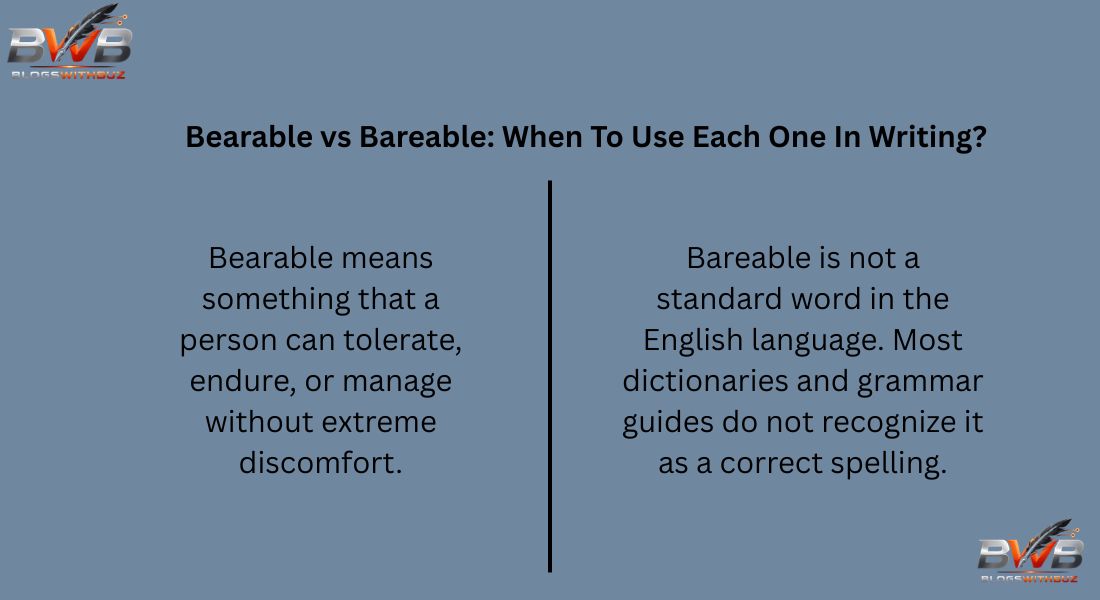
Bearable means something that a person can tolerate, endure, or manage without extreme discomfort. In simple terms, a situation is bearable when it feels difficult but still possible to handle. People often use this word to describe pain, stress, weather, noise, or emotional discomfort that does not become overwhelming.
For example, mild pain after exercise may feel bearable, while strong pain may feel unbearable. In everyday English writing and communication, the word helps explain the level of discomfort in a clear way.
The definition of bearable also relates to something that remains tolerable and manageable. Using this word correctly improves grammar, sentence clarity, and vocabulary in both formal and informal writing.
Define Bareable
Bareable is not a standard word in the English language. Most dictionaries and grammar guides do not recognize it as a correct spelling. People usually write bareable by mistake when they actually mean bearable, which describes something tolerable, manageable, or able to be endured.
Because of this spelling confusion, writers should avoid using bareable in formal or professional writing. Correct grammar and word usage are important for clear communication. Using the wrong spelling can confuse readers and reduce writing clarity.
In simple terms, if you want to describe pain, discomfort, or a difficult situation that someone can handle, the correct word choice is bearable, not bareable.
Maintained vs Maintenanced: Meaning And Differences
How To Properly Use The Words (Bareable or Bearable) In A Sentence
The correct word is bearable, which means something tolerable or manageable. The spelling bareable is usually a mistake and is not accepted in standard English grammar. Writers should use bearable when describing pain, discomfort, stress, or difficult situations that a person can still endure or handle.
How To Use ‘Bearable’ In A Sentence
Use bearable to describe a situation, feeling, or condition that a person can tolerate or endure. The word often appears in sentences about pain, discomfort, weather, stress, or noise that is difficult but still manageable. In English writing, using bearable helps explain that something is unpleasant but not overwhelming.
For example, you can say;
- The pain from my injury was bearable after taking medicine.
- Despite the heat, the weather was bearable thanks to the shade.
- The noise from the construction site was bearable with headphones on.
- Although the workload was heavy, it was bearable with my team’s support.
- The long flight was bearable because of the in-flight entertainment.
Using bearable correctly improves grammar, vocabulary, and sentence clarity. It also helps writers describe tolerable situations in a clear and natural way in everyday communication.
How To Use ‘Bareable’ In A Sentence
The word bareable is not a recognized word in English. It is usually a spelling mistake when people mean bearable. In formal writing or professional communication, you should avoid using bareable because it can confuse readers and reduce the clarity of your writing.
If you see bareable, always replace it with bearable. For example, instead of writing, “The pain was bareable,” the correct sentence is: “The pain was bearable.”
In short, bareable should not be used in any standard English sentences, as it is incorrect and can make your writing look unprofessional. Always choose bearable to describe something tolerable, manageable, or endurable.
More Examples Of Bearable or Bareable Used In Sentences
Here are clear examples to show the correct and incorrect usage of these words. This will help you understand when to use bearable and why bareable should generally be avoided.
Examples Of Using Bearable In A Sentence
- The pain from my injury was bearable, but still uncomfortable.
- Working in the heat was bearable thanks to the air conditioning.
- The noise from the traffic outside was just about bearable.
- Although the hike was challenging, it was bearable for most of us.
- She found the wait for her appointment bearable because she had a good book.
- The workload was heavy, but it was still bearable with teamwork.
- The discomfort from the dental procedure was bearable thanks to the anesthetic.
- He found the cold weather bearable because he dressed warmly.
- Although the flight was long, it was bearable because of in-flight entertainment.
- The pain from her migraine was bearable thanks to medication.
- The traffic jam was bearable because I listened to music.
- The classroom noise was bearable with the windows closed.
Examples Of Using Bareable In A Sentence
Note: Bareable is not a recognized English word, so all these examples are either incorrect or hypothetical. They should generally be replaced with bearable in proper writing.
- The heat was bareable, but this is incorrect; use bearable.
- The workload seemed bareable, though the correct word is bearable.
- She thought the pain was bareable, but it should be bearable.
- The traffic noise was bareable, which is a spelling mistake.
- The long meeting was bareable, better written as bearable.
- His stress felt bareable, though bearable is correct.
- The cold weather was bareable, but the proper word is bearable.
- The construction noise was bareable, though incorrect.
- The flight delay was bareable, should be bearable.
- The test was bareable, better to write bearable.
- The emotional discomfort was bareable, incorrect spelling.
- The pain from surgery was bareable, always bearable.
Common Mistakes To Avoid
When writing in English, it’s easy to make mistakes with words that sound similar. Paying attention to correct spelling and meaning will help your writing stay clear and professional.
Using “Bareable” Instead Of “Bearable”
A common mistake is using bareable when you actually mean bearable. Remember, bareable is not a recognized word. For example, writing “The pain was bareable” is incorrect. The correct sentence is: “The pain was bearable.” Always use bearable for something tolerable, manageable, or endurable.
Using “Bearable” Instead Of “Barely”
Some people confuse bearable with barely. These words have very different meanings:
- Bearable = tolerable or manageable
- Barely = just enough or hardly
Incorrect: “I bearable made it to the meeting.”
Correct: “I barely made it to the meeting.”
Confusing “Bearable” With “Bearish”
Another mistake is mixing up bearable with bearish, which is used in finance to describe a pessimistic outlook on the market. For example:
Incorrect: “The situation was bearish, but it should be bearable.”
Correct: “The situation was bearable, not overwhelming.”
Tips To Avoid These Mistakes
- Always double-check the spelling and definition of a word.
- Use a dictionary or thesaurus to confirm correct usage.
- Read your sentences out loud to spot homophone errors.
- Practice writing bearable in different contexts to build confidence.
- Avoid using bareable, unless intentionally for stylistic or creative purposes.
By following these tips, your writing clarity, grammar, and professional tone will improve significantly.
Context Matters
Choosing between bearable and bareable depends on the context in which you use the word. While they may sound similar, their meanings and appropriateness can change based on the situation. Bearable is used for pain, discomfort, stress, or difficult situations that can be endured, whereas bareable is not a recognized word and is only used mistakenly or hypothetically. Understanding the situation helps you write clearly and avoid confusing readers.
Examples Of Different Contexts
| Context | Example Sentence | Preferred Word |
| Physical Discomfort | “The pain was almost ________.” | Bearable |
| Emotional Distress | “The thought of losing her was ________.” | Bearable |
| Extreme Difficulty | “The task was ________.” | Bearable |
| Minimal Difficulty | “The task was ________.” | Bareable (hypothetical) |
| Lack of Coverage | “The ground was ________ of vegetation.” | Bareable (hypothetical) |
Explanation:
- In situations like physical pain, emotional stress, or difficult tasks, bearable is correct because the situation can still be endured.
- In cases emphasizing minimal difficulty or lack of coverage, bareable might appear in theory, but it is not standard English. Writers should stick to bearable for clarity and correctness.
Exceptions To The Rules
While the rules for using bearable and avoiding bareable are usually straightforward, there are a few exceptions where context or purpose may change their use.
1. Regional Differences
In some regions or dialects, people may occasionally use bareable more often than bearable. However, this is not standard English and may be considered incorrect in formal writing. Always use bearable in professional or academic contexts to maintain clarity.
2. Technical Terminology
In technical fields, especially in engineering or science, words may be adapted for specific meanings. For example, bareable could hypothetically describe a surface that can be stripped or exposed, while bearable might refer to a system load or stress that can be tolerated. Even here, using bearable for tolerable conditions is far more common.
3. Creative Writing
Authors and poets sometimes play with language for stylistic effect. In creative writing, an author might use bareable intentionally to suggest vulnerability, rawness, or artistic expression, while bearable conveys endurance or tolerance. Even in creative contexts, readers should understand the intended meaning.
Summary:
Although these exceptions exist, in most formal, academic, and professional writing, the correct choice is always bearable.
Practice Exercises
These exercises will help you practice using bearable correctly and avoid mistakes with bareable.
Exercise 1: Fill In The Blank
Choose the correct word (bearable or bareable) to complete each sentence:
- After the accident, the pain was ______.
- Despite the hot weather, the temperature was ______.
- He found the noise from the construction site ______.
- The workload was ______, but he managed to finish on time.
- The loss of his pet was ______, but he knew he had to move on.
Answer Key:
- bearable
- bearable
- bearable
- bearable
- bearable
Exercise 2: Write A Sentence
Write a sentence using each of the following words correctly:
| Word | Example Sentence |
| bearable | The pain in my back was bearable after taking medicine. |
| bareable | The room was not bareable due to the lack of air conditioning. (Note: In standard English, replace with bearable.) |
Tip: In real writing, always use bearable for clarity, tolerability, or manageable situations. Bareable is usually a misspelling or used only in creative/hypothetical contexts.
Conclusion
In summary, the correct word to use is bearable, which means something tolerable, manageable, or endurable. The word bareable is not recognized in standard English and should generally be avoided. Bearable is used to describe pain, discomfort, stress, or difficult situations that can still be handled. Common mistakes include confusing bearable with barely or bearish, and using bareable instead of bearable. Understanding the meaning, context, and proper sentence usage of bearable improves writing clarity, grammar, and communication skills. By practicing examples and exercises, writers can use bearable confidence in all forms of writing.
Key Takeaways
- Bearable is the correct word for anything tolerable, manageable, or endurable.
- Bareable is not a recognized word and should be avoided in formal writing.
- Use bearable to describe pain, discomfort, stress, or difficult situations.
- Common mistakes include confusing bearable with barely or bearish.
- Context matters: bearable fits situations of endurance, while bareable is only hypothetical or creative.
- Always double-check spelling and meaning to improve writing clarity and grammar.
- Practicing examples and exercises helps writers use bearable confidently in sentences.
Frequently Asked Questions
What is the difference between bearable and bareable?
Bearable is a correct English word meaning tolerable or manageable, while bareable is not a recognized word and is usually a spelling mistake. Always use bearable in formal writing.
Can I use bareable in a sentence?
It is best to avoid using bareable in standard writing. If you mean something tolerable or endurable, use bearable instead. Bareable may appear only in creative or hypothetical contexts.
How do I remember when to use bearable?
Think of bearable as something you can “bear” or endure. Use it for pain, discomfort, stress, or difficult situations that can still be managed.
Read more: