Many people often get confused when they see the words stich and stitch. They look almost identical, and it is easy to think they are the same. However, the small difference of a single letter “t” changes the meaning completely. Knowing which one is correct is important, especially in writing, sewing, medical contexts, and even when using idioms in English.
In this article, we will explore the difference between stich vs stitch, explain their meanings, show examples, and help you use the correct word every time. By the end, you will clearly understand why “stitch” is almost always the right choice.
What Does “Stich” Mean?
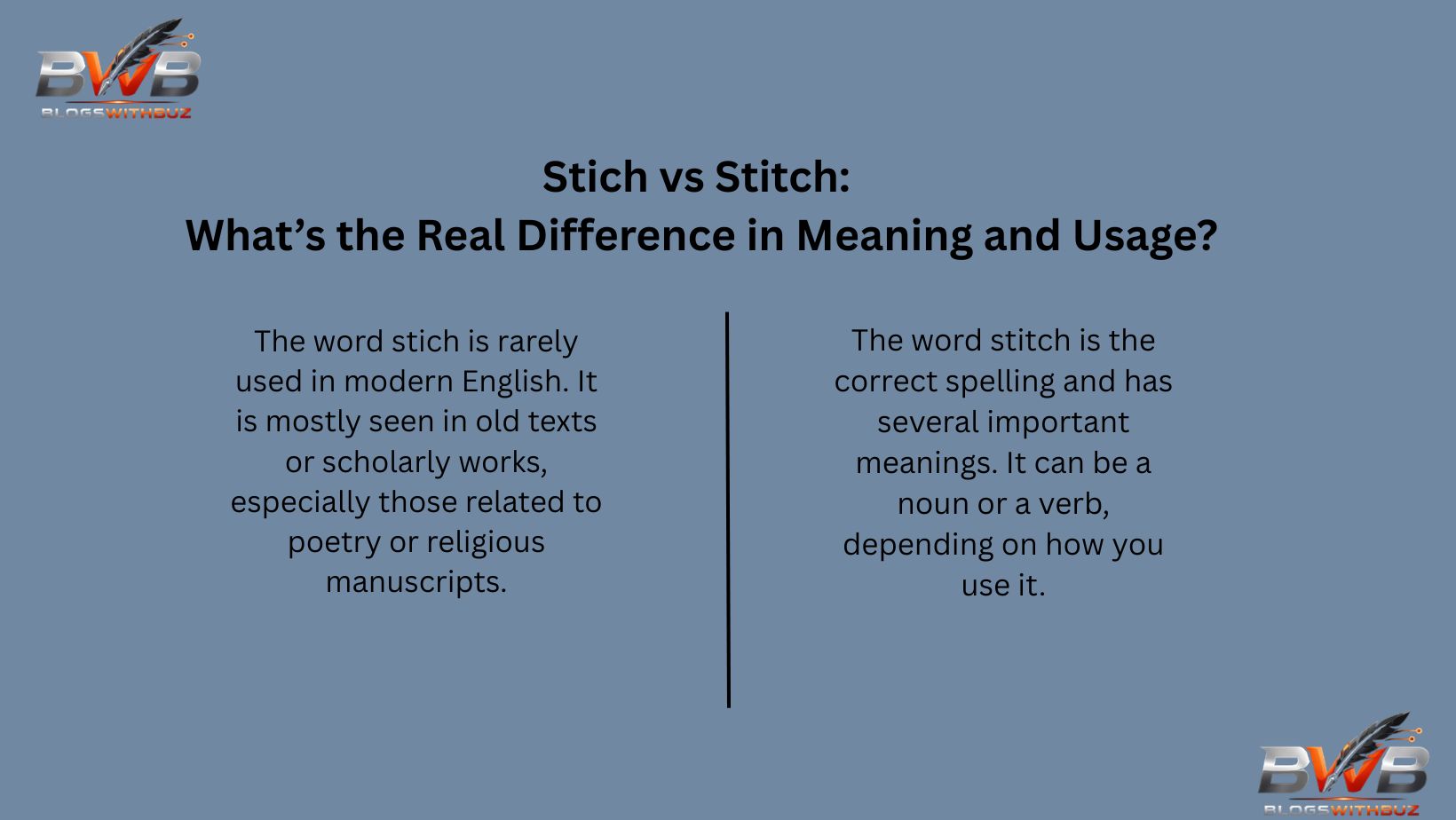
The word stich is rarely used in modern English. It is mostly seen in old texts or scholarly works, especially those related to poetry or religious manuscripts.
The Rare and Historical Meaning of Stich
In ancient times, stich referred to:
- A single line of verse in poetry
- A rhythmic line in Hebrew poetry or biblical texts
- A line as written in old manuscripts, especially in the Old Testament or Hebrew Scriptures
For example, when studying the oldest Hebrew manuscripts, scholars might mention a “stich” to describe one line of a poetic structure. This usage is strictly academic and not something you would use in everyday English writing.
Is Stich Correct in Modern English?
Although “stich” has a historical meaning, in most modern contexts, it is considered a spelling mistake. People sometimes type “stich” when they mean “stitch,” especially in informal writing or blogs.
For example:
- “The doctor gave him five stiches after the surgery.” ❌
The correct sentence should be: - “The doctor gave him five stitches after the surgery.” ✅
So, when comparing stich vs stitch, remember that “stich” is almost never the correct spelling in daily English.
What Does “Stitch” Mean?
The word stitch is the correct spelling and has several important meanings. It can be a noun or a verb, depending on how you use it.
Stitch as a Noun
Sewing and Fabric Work
A stitch is a single pass of a needle and thread through fabric. When you sew clothes, each loop or line made with thread is called a stitch.
For example:
- “The tailor added small, neat stitches to repair the torn pocket.”
- “She carefully stitched the edge of the dress to prevent fraying.”
Sewing stitches are the basic building block of creating and repairing fabric items. Without stitches, clothes, bags, and other textiles could not hold together.
Knitting
In knitting, a stitch refers to a loop of yarn on a needle. Knitters carefully follow patterns of stitches to make scarves, sweaters, or blankets.
For instance:
- “I accidentally dropped a stitch, so my knitting pattern got uneven.”
Knitting stitches are essential for both structure and design, and missing or adding stitches can change the final look.
Medical Stitches
In medical terms, a stitch is a thread used to close a wound or surgical incision. Doctors place stitches to help the skin or tissue heal properly and prevent infection.
Example:
- “The surgeon stitched the wound to stop the bleeding.”
- “After the accident, he needed six stitches to close the cut.”
Medical stitches can be made from materials such as nylon, Vicryl, or catgut. Doctors choose different techniques based on the type and location of the wound. Some stitches are single, others are continuous, and some are deep tissue stitches to support healing from the inside out.
Stitch as Pain
A stitch can also refer to a sharp, sudden pain, usually in the side while running or exercising.
Example:
- “I got a stitch in my side during the morning run.”
This meaning is common in sports and everyday conversation. The pain feels like a small needle prick, which is why the word “stitch” fits perfectly.
Stitch in Everyday Expressions
In English idioms, stitch appears in several phrases:
- In stitches: laughing very hard
- Example: “The comedian had the audience in stitches.”
- Example: “The comedian had the audience in stitches.”
- Stitch someone up: tricking or blaming someone unfairly
- Example: “He claimed his colleagues tried to stitch him up.”
- Example: “He claimed his colleagues tried to stitch him up.”
- Stitched together: joined or assembled from parts
- Example: “The report looked stitched together from multiple sources.”
- Example: “The report looked stitched together from multiple sources.”
These idioms show how versatile the word “stitch” is beyond sewing and medical contexts.
Stitch as a Verb
The verb form of stitch also has multiple uses:
- To sew or join with thread
- “She stitched the fabric carefully to make a clean hem.”
- “She stitched the fabric carefully to make a clean hem.”
- To close a wound
- “The doctor stitched the cut to help it heal faster.”
- “The doctor stitched the cut to help it heal faster.”
- Figurative use (idioms)
- “They tried to stitch him up with false accusations.”
- “They tried to stitch him up with false accusations.”
Stich vs Stitch: Key Differences Explained
To make the difference crystal clear, here’s a simple comparison:
| Feature | Stich | Stitch |
| Spelling | Rarely correct | Correct |
| Usage | Old poetry, manuscripts | Sewing, medical, idioms, pain |
| Modern English | Not common | Widely used |
| Daily Life | Almost never | Everyday English |
Summary: “Stitch” is the correct word in almost every context. “Stich” is either an outdated academic term or a spelling error.
Why Do People Confuse Stich and Stitch?
The confusion happens for several reasons:
- Typing errors: When people type quickly, they often miss one “t.”
- Pronunciation: The “t” in stitch is soft, so it can be hard to hear.
- English learners: Double letters in words like “little,” “better,” or “bottle” can confuse non-native speakers.
- Auto-correct tools: Sometimes spellcheck doesn’t catch the mistake.
Understanding these reasons helps avoid repeated errors.
Common Mistakes and How to Avoid Them
Even native speakers make mistakes with stich vs stitch. Here are some tips:
- Always proofread your writing.
- Remember: if it involves sewing, wounds, knitting, or pain, it’s stitch with a double “t.”
- Avoid confusing “stitch” with similar words like stick.
- Use a memory trick: “If it holds things together, use stitch with two ‘t’s.”
Frequently Asked Questions
Is stich a real word?
Yes, but it is very rare and mostly used in old poetry studies. In modern English, it is considered a mistake.
What is the difference between stich and stitch?
Stich is rare and outdated. Stitch is the correct word for sewing, medical wounds, knitting, and idioms.
What does stitch mean in medical terms?
In medicine, a stitch is a thread used to close wounds or surgical incisions to help them heal properly.
What is a stitch in knitting?
A stitch is a loop of yarn on a needle that forms part of a knitting pattern.
What does “in stitches” mean?
It means laughing very hard.
Final Thoughts
The confusion between stich vs stitch is common, but easy to fix. Remember:
- Stich: mostly a rare or outdated word.
- Stitch: correct spelling in everyday English, sewing, medical, knitting, and idioms.
Whether you are writing a blog, sewing clothes, studying poetry, or reading medical instructions, using the correct word is important. Always double-check your spelling, and you will never mix up stich vs stitch again.
By understanding the meanings and correct usage, you can write with confidence, clarity, and accuracy.
Read more: