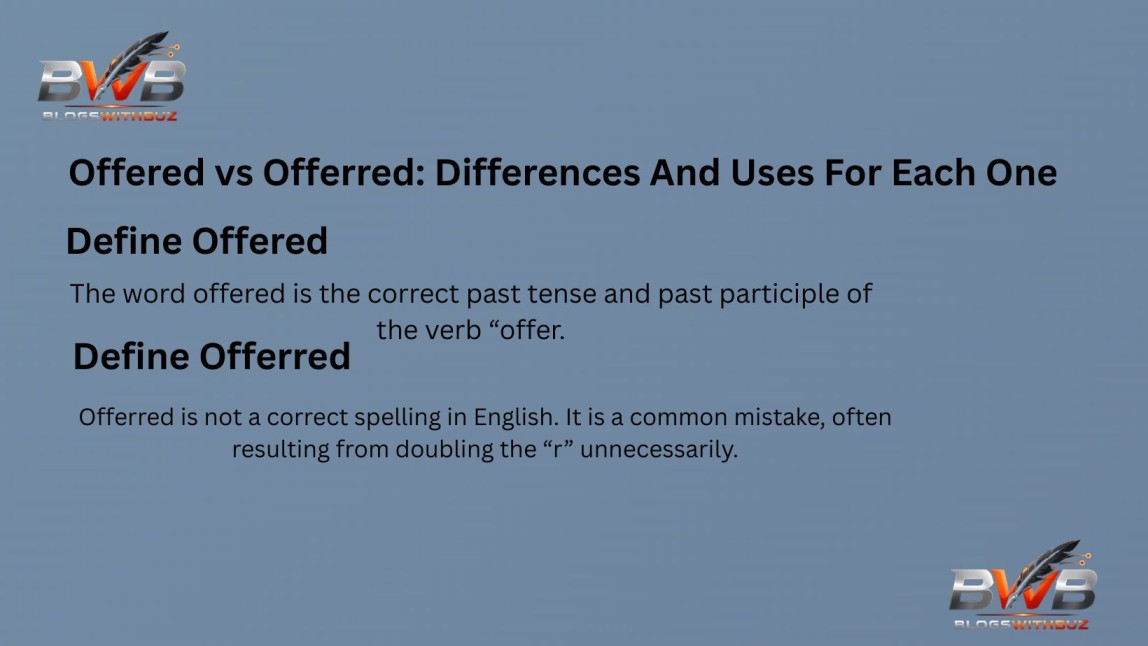
Understanding the difference between Offered vs Offerred is essential for clear communication. Many writers, students, and professionals often struggle with spelling and usage. This guide provides a complete explanation, examples, and exercises to master these words in English. By the end, you’ll confidently know when to use each one correctly.
Define Offered
The word offered is the correct past tense and past participle of the verb “offer.” It means to present, propose, or make something available for someone to accept or consider. Whether suggesting advice, presenting a gift, or providing a service, offered is the professional and standard form. For example, saying, “She offered her expertise to the team” communicates that the action was completed clearly and effectively.
Define Offerred
Offerred is not a correct spelling in English. It is a common mistake, often resulting from doubling the “r” unnecessarily. Writers who use offerred risk appearing careless or unprofessional. Always remember to use offered instead, especially in formal writing or business communications. Intentional misspelling may occur in literature, but it is rare and should be deliberate for stylistic purposes.
How To Properly Use The Words In A Sentence
Proper usage ensures clarity. While offered is correct, some may confuse it with offering, the present participle, or accidentally write offerred. Understanding tense, context, and audience is crucial.
How To Use “Offered” In A Sentence
Offered is used to describe actions completed in the past. For example:
- He offered me a job opportunity.
- The store offered a special discount on all products.
- She offered her condolences to the grieving family.
In each case, the verb indicates that the action is done, emphasizing completed proposals, suggestions, or presentations.
How To Use “Offerred” In A Sentence

Since offerred is incorrect, it should be avoided. Writers must replace any occurrence of offerred with offered. For example, instead of writing, “He offerred his help,” correct it to, “He offered his help.” This maintains professionalism and avoids grammar errors.
More Examples Of Offered & Offerred Used In Sentences
Practical examples help reinforce understanding and prevent mistakes.
Examples Of Using “Offered” In A Sentence
- The company offered a generous severance package to employees.
- She offered to assist me with my moving tasks.
- He offered his services as a consultant to the startup.
- The hotel offered complimentary breakfast to all guests.
- The university offered a variety of courses in business, arts, and engineering.
Examples Of Using “Offerred” In A Sentence
All sentences with offerred are incorrect. For example:
- “She offerred her opinion on the project” → Correct: “She offered her opinion on the project.”
- “He offerred assistance to the elderly” → Correct: “He offered assistance to the elderly.”
Understanding that offerred is not a valid word prevents common spelling mistakes.
Common Mistakes To Avoid
Mistakes often arise from misusing tense, confusing participles, or ignoring standard spelling rules.
Using “Offered” And “Offerred” Interchangeably
Many writers mistakenly use offerred as if it were correct. Remember, offered is always the proper spelling in all contexts. Avoid writing offerred in formal or informal communication.
Using “Offered” When “Offering” Is The Correct Form
Sometimes, people write, “I offered to help,” when describing a present or ongoing action. In such cases, the correct form is offering: “I am offering to help.” Proper tense ensures clarity and prevents confusion.
Using “Offerred” Instead Of “Offering”
Occasionally, writers incorrectly use offerred instead of the gerund form offering. Avoid this mistake. Correct usage emphasizes ongoing actions: “She is offering support to students.”
Summary
Correct spelling, context, and tense are crucial. Always use offered for past actions, offering for present continuous actions, and never use offerred except stylistically in fiction.
Context Matters
Understanding context affects which form you use and ensures your writing is professional.

Examples Of Different Contexts
- Formal Writing: offered is standard.
- Informal Writing: some may mistakenly type offerred, but offered remains correct.
- British English: offered preferred.
- American English: offered always correct; offerred is nonstandard.
- Present Tense: use offering, not offered.
- Past Tense: always offered.
Exceptions To The Rules
There are some special cases, but they rarely change the core rule.
Compounds Of “Offer”
Words like “offeror” or “offerings” do not require a double “r.” For example:
- The offeror presented a compelling case.
- Company offerings included multiple options for clients.
Regional Variations
British English consistently uses offered, while American English never recognizes offerred as standard. Avoid using it to maintain professionalism.
Intentional Misspelling
Writers may use offerred creatively to reflect dialects or character speech in fiction. This is stylistic, not grammatical.
Practice Exercises
Hands-on practice reinforces learning.
Exercise 1: Fill In The Blank
Choose the correct form:
- The company ______ a free trial of software.
- She ______ to help me with my project.
- He ______ to pay for dinner.
- The job was ______ to me last week.
- They ______ a discount for bulk purchases.
Answer Key: all blanks → offered
Exercise 2: Rewrite The Sentence
Correct the mistakes:
- The job was offerred to me last week. → The job was offered to me last week.
- He has never offerred help before. → He has never offered help before.
- They offerred discounts if you buy in bulk. → They offered discounts if you buy in bulk.
Conclusion
Mastering Offered vs Offerred improves clarity, professionalism, and accuracy in writing. Always choose offered for past actions, use offering for ongoing actions, and avoid offerred unless stylistically required. Attention to context, tense, and spelling ensures your English is precise, confident, and effective. Practicing with examples and exercises strengthens proper usage and eliminates common mistakes, making your communication more polished and credible.
FAQs
What is the difference between offered and offerred?
Offered is correct past tense; offerred is incorrect and should be avoided in all formal writing contexts.
Can I use offerred in American English?
No. Offerred is never standard in American English. Always use offered for past actions.
How do I know when to use offering?
Use offering for present continuous actions or ongoing proposals, not for past events.
Are there exceptions to the spelling rules?
Intentional stylistic use in fiction may use offerred, but standard grammar always requires offered.
What are common mistakes with offered vs offerred?
Writing offerred instead of offered or using offered for ongoing actions instead of offering are frequent errors.
Read more:Blogs with Buz